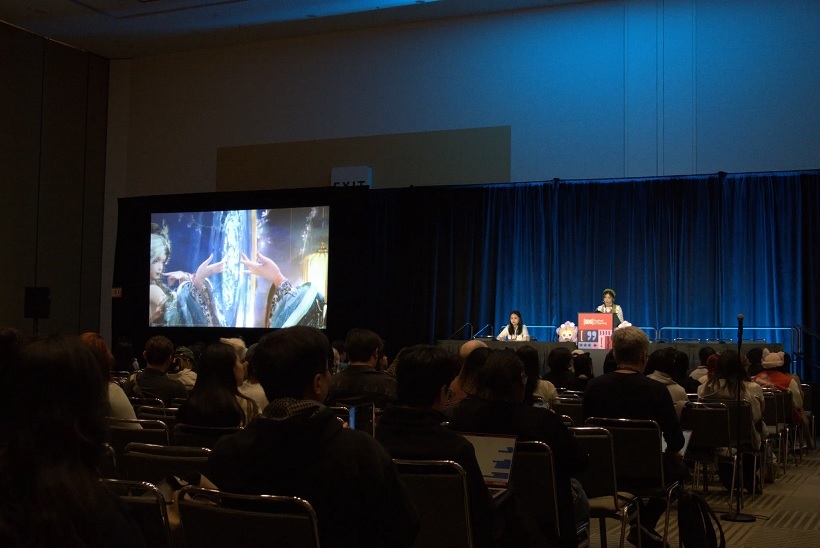
Global game developer Infold Games participated in this year’s Game Developer’s Conference (GDC), holding a series of talk sessions discussing the development process of its two major titles, Love and Deepspace and Infinity Nikki. Having launched worldwide in 2024, Infinity Nikki is the studio’s acclaimed free-to-play open world action-adventure game, and the fifth installment in the long-running Nikki series with a unique focus on fashion and dress-up mechanics. During GDC, Dodie, the game’s art director, shared some insight into the game’s fashion design philosophy, explaining the intricate process behind the creation of Infinity Nikki’s dreamlike outfits.
In this article, we bring you the full lecture by Dodie, courtesy of Infold Games.
An open world that uses fashion to paint dreams
I loved daydreaming when I was a kid. When I wrapped myself in a long blanket, I felt like a fairy; when I draped the blanket over my shoulders, I felt like a wandering swordswoman. After I joined INFOLD GAMES and understood the unique design philosophy here, I suddenly recalled those childhood feelings. I realized that the essence of fashion design is to weave dreams for everyone who yearns to discover beauty.
In my heart, Infinity Nikki is an open world that uses clothing to paint dreams. Compared to previous entries in the series, the open-world setting sharpens the backdrop of these dreams from a hazy blur to crystal clear. The outfits are like rabbit holes leading into a dreamscape; put them on, and you fall right into this “illusion”.
So, how do we “create dreams?” It sounds like a highly abstract concept. Through continuous development, we have summarized some dream-weaving techniques, which I am honored to share with you here on behalf of the Infinity Nikki art team.
“Create dreams”, the first thing to do is to think from the dimension of feeling-based design.
I’d like to talk to you about “dreams” first. We all dream, and we’ve had countless dreams. Everyone can recall their most unforgettable dream—the exact moment that pops into our heads right now. Why do we still cherish it in our hearts to this day?
I believe most people’s answers would be the same as mine: not because the visuals in that memory were overwhelmingly rich, but because our hearts were deeply touched in that very moment. Whenever that moment resurfaces, ripples form in our hearts—perhaps beautiful, warm, or sorrowful—but always moving and unforgettable. This is the first point I want to share: what we aim to create are “dreams” that touch people’s hearts.
I believe a good fashion design is never just about how gorgeous its visual effects are, but rather lies in the deeper, emotional dimension of design and communication behind it. This is especially true in the dress-up game genre, which features hundreds or thousands of outfits.
The amount of visual information does not equal the amount of design content. A design formed by haphazardly piling things together cannot touch the heart; it’s like a flashy but empty shell, a fleeting dream that is easily forgotten. Conversely, clothing that evokes our deepest feelings will resonate more with people and make them want to obtain it. This requires us to construct and reinforce “feelings” through design language during the design process, from the overall conceptual elements down to the lace patterns on the cuffs. Only then can those touching “ripples” be translated step-by-step, layer-by-layer, into tangible stitches and threads, ultimately weaving into a moving “dream”.
Theory alone is a bit abstract, so I have prepared two outfit cases from Infinity Nikki to share the design thinking behind them. The first outfit is “Behind Prayers.”
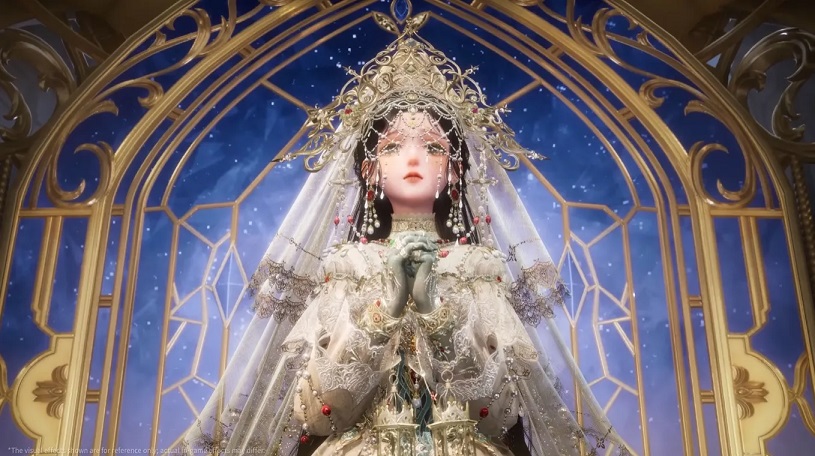
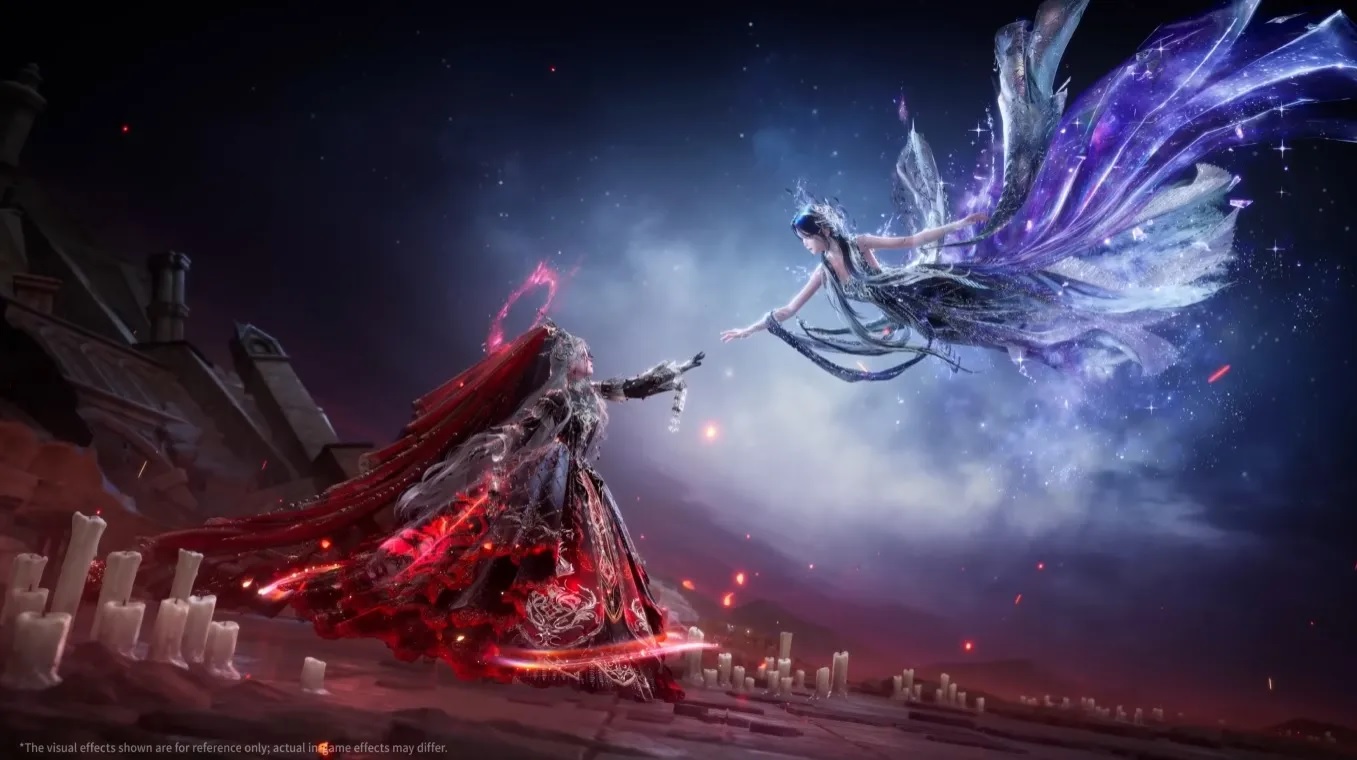
The Holy Maiden is wearing her “splendid imprisonment” through “Behind Prayers”
The initial starting point for this outfit’s design was a human girl chosen to be a Holy Maiden. Speaking of this, I’m sure many “Holy Maiden” characters or themed outfits have popped into your heads, right? Everyone loves creating around this theme, but how do we make it unique and impressive?
Therefore, before we started drawing, the first thing we did was to discuss with our writing colleagues to deepen the lore and determine the main color tone of this dream. So the story unfolded further: this girl was elected by her people, and she dedicated her entire life to them, praying day and night in a high tower. Becoming a revered Holy Maiden seems like a good thing, but the girl lost her freedom from then on. There’s a hint of sorrow and heaviness, right? Now we’ve found the very first thread to weave this dream.
The identity of the Holy Maiden brings her worldly prestige, but it is also a heavy shackle of confinement. To convey this feeling of “splendid imprisonment”, the art team adhered to maximalism in the overall design. The Holy Maiden is draped in layered, heavy garments, covered all over with gorgeous and exquisite artificial decorations, dazzling yet incredibly burdensome.
The entire outfit uses an elegant pale gold as its main color tone, laid out with delicate, beautiful lace and complex embroidered background patterns, utilizing heavy-duty fabrics of different textures to create rich layers.
The hat design references the Byzantine style, creating a dazzling golden holy crown studded with fiery gemstones. On the back, we added a long trailing veil connected to the crown. The whole piece uses a layered tulle technique, fully covered with gorgeous gold-stamped patterns and adorned with ruby-inlaid beaded chains, to create a voluminous and draped visual texture.
To make the Holy Maiden more magnificent and mysterious without overly obscuring her face, the face veil was specially designed to be made of pearls. The pearls dangling at the ends resemble tears quietly sliding down the Holy Maiden’s face; this touch of sorrow is both the Holy Maiden’s compassion for the world and a lament for her own fate.
The metal cage dangling at her wrist is the most straightforward symbol of a “shackle” in this outfit. Its outline is exquisite yet cold, swaying at the wrist with her movements like a delicate pair of handcuffs, yet the cage is empty. We hope to express the Holy Maiden’s inner yearning for freedom through this negative space design; even though she is in a splendid imprisonment, her soul has long broken out of the cage.
As for the shoe design, the imagery of “shackles” is transformed into ornate gemstone decorations, wrapping and intertwining around the ankle layer by layer. The heel is based on a hollowed-out structure, into which a sharp blade is inserted diagonally, presenting a sense of fragility and unease as if about to collapse.
At the same time, to allow the audience to quickly enter the dream, the moment this outfit is put on in the game, we have Nikki perform a sequence that echoes the concept very immersively. This replaces the traditional functional poses that mainly show off clothing details, further expressing the narrative and emotional design of the outfit.
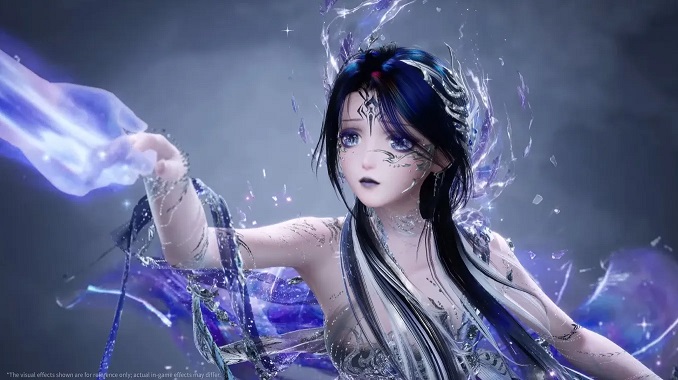
Designing the tragic fate of a scarred but resilient Goddess with “Born Flawless”
Next is another outfit, “Born Flawless”. The initial starting point for this outfit was the “Daughter of a God”. A Goddess—this is also a familiar concept. We think of various goddesses in mythology: gentle, solemn, beautiful, but also a bit conventional, right?
So, similarly, we first had an extended discussion on the lore with our writers, and we caught a very crucial “thread”: the daughter of the god is an unknown deity who, from birth, has been bearing the suffering and pain of this land. The most direct feeling is sorrow caused by an unfortunate fate, but we wanted to try a deeper expression. So, we changed our perspective to view this story.
A deity facing a tragic fate alone does not have to wallow in self-pity. She can appear fragile but be incredibly sharp; the darkness and pain of the mortal world can never obscure her innate brilliance. This is the new starting point we ultimately chose to develop the design.
First, we chose “scars” as the core concept, but not scars in the literal sense. What we wanted to express is that the original appearance of pain is softened, and instead presented with an exquisite, pure, and sacred feeling. For this solitary and noble deity, even if her fate is shattered and she is covered in cuts and bruises, her past and scars have not diminished her divinity, but rather transformed into unique textures and radiance.
The design core of this outfit lies in her back. All the extending details are designed around this visual focal point. The winding patterns on the back are an artistic translation of scars, metaphorically representing the pain the Goddess has endured. The entire outfit almost completely discards traditional “artificial” decorative patterns; all streamlined ornaments are scars of different forms that have been artistically processed.
The Goddess’s hairstyle design was also carefully considered, pulling the long hair to the front to fully reveal the design on the back. The design of the hair ends is inspired by the feathers of an injured bird, layered, soft, and uneven, which, together with the scar patterns on the back, construct a fragile yet moving beauty.
In terms of material design, the hair strands have a superimposed layer of iridescent luster like diamond scattering, and some strands are treated with a positive and negative space effect of a starry river, hoping to make the overall temperament more divine, mysterious, and dreamy.
When designing the clothes and shoes, to reflect the ethereal, non-human divine feeling of the entire outfit, we wanted both to feel more like extensions of the deity’s body, seamlessly natural as a whole, rather than artificial decorations. Therefore, the shoe design is not a traditional high heel style, but uses a metal hollowed-out design spreading to the toes, without even a heel.
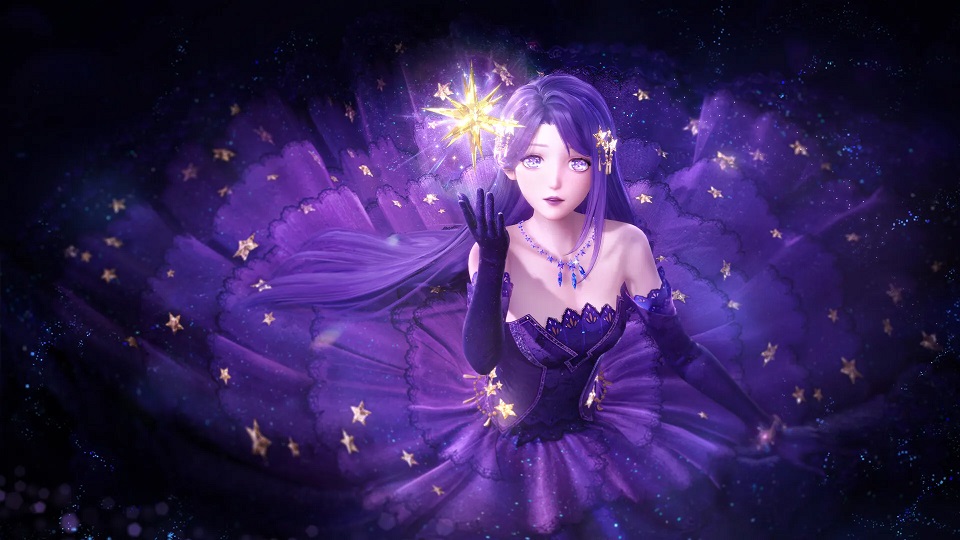
As for the skirt design, we chose a style that fits close to the body, with tailored lines stretching down along the torso. The hem incorporates artistic scar patterns that echo the back. On the back of the outfit, we designed a heavily expansive, gorgeous, and imposing special-effect train, like a flowing starry sky. The edges feature shattered star fragments, echoing the “scar” concept and complementing the overall back styling.
On the crown, we designed a dual form, corresponding respectively to the two sides of the Goddess’s inner self: perfect divinity and shattered scars. In its complete form, the crystal-clear crown envelops the Goddess; it is a symbol of flawless divinity, silently demonstrating her inviolable majesty. When it transforms into its shattered form, it is like fragments of the starry sky, floating lightly around the Goddess, using a flowing and romantic posture to express the fragility and sorrow of the Goddess that is unknown to the world.
Similarly, we designed the entrance animation for this outfit with a performance that matches the concept accordingly. The Goddess is born from a shattered void. As the deity gently sweeps her hands and her robes flutter, pain and injury surround her. Beneath her coldness hides a trace of confusion and sorrow, yet the world does not understand what this means—this is exactly the feeling the entire outfit aims to present.
Weaving together outfit concepts with practical abilities
On the other hand, in Infinity Nikki, putting on an “Ability Outfit” grants a certain mysterious Whim magic, allowing for better exploration in the world. The open world brings more dimensions of expression to clothing display, and the high integration of the two makes the worldview more immersive and interesting.
When we design the visual representation of outfit abilities, aside from functional rationality, we also pay attention to the unification of feeling and concept. Even with the same type of ability, during design, we combine different clothing design concepts to create different artistic expressions. The selection and design of abilities is also a further reinforcement to elevate the emotional value of the clothing.
In the open world, the basic Sticky Claw ability is an outfit ability that allows you to swing and move like Spider-Man. Nikki shoots out a Sticky Amber grappling hook that sticks to other Sticky Amber on interactive objects in the environment, allowing her to rapidly traverse through Snail Town. For ease of movement, the basic ability outfit uses a very sleek Earth Alliance style cut, adorned with Sticky Amber gemstone decorations to echo the theme.
However, in the Sticky Claw ability design for “Behind Prayers”, the art concept is “the moment of escaping worldly confinement”. The girl opens the cage door, the heavy beaded chains on her body fling out, and gemstones burst forth, turning into grappling hooks flying toward freedom, soaring together with the little dragon from the cage. In the ability design, flying in the air not only brings a brand-new control experience for exploration, but also symbolizes “running towards freedom”, echoing the theme of the Holy Maiden breaking through shackles and casting off restraints.
At the same time, as a revered Holy Maiden, her power is inherently born to protect her companions. Therefore, her Sticky Claw ability is designed to be accompanied by a friend, and there is also a space for companionship when hovering.
For “Born Flawless”, we chose the combat bow and arrow ability, which fully demonstrates the Goddess’s determination to fight against destiny. To fit the concept of divinity, the ability design does not use a traditional bow and arrow as a weapon, but instead focuses on expressing the Goddess’s own power. She is so “dazzling” that she is “sharp”; with a gentle wave of her hand, she can tear through the night sky, and fragments of stars turn into her arrows, striking enemies directly.
In the skill design, we used many elements associated with the vast universe, including transforming into a radiant light to break through confinement, summoning a black hole that absorbs monsters, and an ultimate move that tears through the sky causing an atmospheric change. This also highlights the power to manipulate nature possessed by the Daughter of a God.
In addition to the in-game content, in the PV showcasing the outfits, we also abandoned the conventional direction of outfit displays. We integrated the aforementioned deeper feelings and conceptual design points into the choreography of the performance, presenting them to the audience in a more intuitive way.
I personally really love the overall conceptual design of these two outfits, as well as the expression on the feeling level; they are both fighting against fate in their own ways. Through such deep content design, we stimulate the audience’s imagination and resonance. Even for relatively conventional themes like Holy Maidens and Goddesses, they can be combined with different feelings to ultimately present a unique visual charm. This is also one of the secrets of the Nikki series: being able to continuously generate new inspiration even with the premise of already having thousands of outfits.
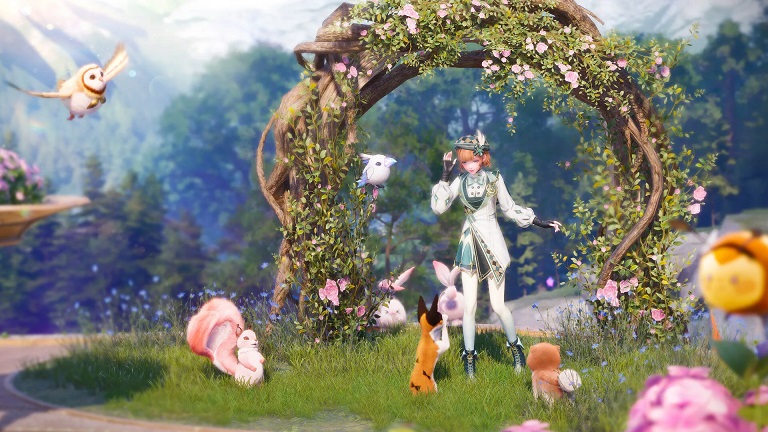
Fashion as worldbuilding: “Not just a carrier for system gameplay, but a part of the world’s ecosystem”
The second point, dreams originate from what we see and feel in the open world.
There is a Chinese saying, “What you think about by day, you dream of by night”. The content of a dream originates from what we have seen, experienced, and thought about in this world. It can be said that the world is the raw material for creating dreams, and it also paints the most basic background color for the dream. Only a dream that allows people to fully engage can better convey feelings and design; a dream that breaks character, no matter how clear the content before you is, cannot make people immerse themselves in it.
Therefore, in Infinity Nikki, we need an immersive world that makes people believe enough that “clothing is a dream”. Clothing is not just a carrier for system gameplay; by making clothing truly a part of the world’s ecosystem, we make this world that loves dressing up and styling more immersive and credible, which also forms the unique worldview of Infinity Nikki.
For example, in Infinity Nikki, you’ll see that outfits with bee-related themes all use hexagonal patterns. Why is that?
Honeycombs are hexagonal? Hmm… as Earthlings, you might think so, but the people of Miraland don’t design it for this reason.
The answer is very simple: because the bees in Miraland are exactly hexagonal!
As everyone can see, in the world of Infinity Nikki, people use biological elements from Miraland rather than real-world creatures when designing clothes. Whether it’s birds and beasts, fish and reptiles, or even monsters, they all have their own fans in Miraland. These cute little guys not only run and roll in the grass but are also meticulously designed and hidden in the patterns of clothing.
Similarly, when designing the creatures of this world, we also extensively use elements associated with the concept of “clothing”. We don’t know whether the chicken or the egg came first on Earth, but in Miraland of Infinity Nikki, I guess the Brushies must have come before all kinds of makeup brushes.
Furthermore, in Miraland, which values the power of styling, clothing style is an important part of the national settings. We researched various traditional cultural costumes, and people in each region will have their own local styles and attributes that they excel at.
You can also see NPCs who, like Nikki, have their own unique design philosophies and styles. They are the cream of the crop in local styling and are known as “Sovereigns”. We are very particular when designing the outfits for these designers, because after all, the most popular way to battle in Miraland is to have an exhilarating styling showdown with a stylist you admire.
Besides styles, we also express the story and experience of the outfit designers through narrative detail designs; For example, the outfit “Hometown Breeze”, was designed by a young girl recalling her hometown (Harvest Village). It is a small mountain village with rolling wheat fields. In the girl’s memories, there are soft wheat waves brushed by the wind, flower crowns woven by friends with wheat ears and flowers, birds flying over the fields, and windmills spinning in the meadows.
These warm memories will all be presented in her clothing design. You can see that beautiful flower crown, you can see the wheat waves turn into skirt patterns, just like her golden curly hair, rippling in waves when the wind blows; you can see wheat ears rising on her hem, the wind’s song recorded as sheet music wrapping around her dress; you can see the birds turn into earrings, the bird calls seemingly still echoing in her ears; you can see the small windmill from her hometown on her wrist, still accompanying the young girl. You can see the wind of her homeland.
Dreamy outfits created by a blend of real-life logic and artistic processing
Third point, the ultimate pursuit of quality can make dreams come true
Seeing is believing. We hope to make everyone seeking a dream feel that the “dream” is real, and it is right in front of their eyes. Therefore, to better present clothing in the open world, we analyzed and researched a massive amount of real-world materials and clothing craftsmanship, ultimately reproducing them in the game—for example, sweater fuzz, sequins, special woven textures, and so on.
When creating the previously mentioned “Behind Prayers” outfit, to express its ultimate luxury, we developed it by referencing the real logic of fire color layers, reproducing the diamond fire effects found in reality.
Embroidery is also used extensively in the game. In the outfit “Where Wanxiang Weaves Life”, besides common embroidery stitches, we interwoven cording embroidery at the collar and cuffs to further enhance richness and layering.
To improve the display effect of fabrics and to balance the textural performance from both far and near perspectives, we upgraded the fabric textures through multiple iterations based on real fabric weaving logic.
The rich environment of the open world gives clothing more display space, but also brings challenges. In order to make the dynamic performance of clothing vivid and natural, while maintaining a beautiful and dreamy shape, the team created a lot of targeted content.
For instance, for the ribbons of the outfit “Tide of Tears”, we adopted a hybrid solution of cloth physics and bone physics, and added an adaptive dynamic control system. During running movements, it is given a silky smoothness fluttering in the wind; while standing still, the shape control ensures the ribbons can maintain the original form of the clothing, preserving an elegant freeze-frame “as if in water”.
We also frequently encounter situations where clothing needs to display an active swaying and fluttering dynamic. Normal physics and wind effects cannot satisfy this performance, and limited by device performance, the number of bones is restricted. Art and Programming TA jointly developed and integrated an active dynamic fluttering cloth and ribbon system to solve such effect issues involving complex dynamics.
Whether it is static materials or dynamic performance, we base our work on real-world logic combined with artistic processing in the game, striving to achieve a realistic, delicate, yet beautiful and dreamy feeling.
Infinity Nikki is out now for free on PC (Steam/Windows/Epic Games), PlayStation5, and mobile (App Store/Google Play).