Japanese scientists develop Mobile Suit Gundam’s Beam Saber-inspired plasma technology that could help grow and fertilize crops in space
Tohoku University scientists recently revealed new developments on their scientific research based on Gundam's fictional Beat Saber.

As arguably one of the most influential mecha franchises ever, Mobile Suit Gundam has been a long-time inspiration for both sci-fi enthusiasts and actual scientists – so much so that in Japan, they’ve recently even started a project to launch a fully-functional talking robot based on the series’ mascot character Haro into orbit. And on June 9, Japanese media reported on a brand-new development in the field of potential Gundam-inspired scientific breakthroughs.
As reported by The Japan Agricultural News, a team of scientists at the School of Engineering of Tohoku University is currently conducting research that focuses on applied use of technology based on the Beam Saber – a fictional weapon wielded by mobile suits in the Gundam universe – in lunar agriculture. Specifically, they are exploring ways to utilize Beam-Saber-inspired plasma technology to promote plant growth and its resistance to pests and diseases, and (hopefully) enable humans to grow crops on the Moon.
The project is headed by professor Toshiro Kaneko, who is a longtime fan of the Gundam franchise and has been involved in many Gundam-related projects, one of them being Mobile Suit Gundam Universal Century vs. Modern Science, a book exploring the scientific feasibility of Gundam technologies in real life.
In Gundam, Beam Sabers are weapons based on high-energy Minovsky particle (a fictional substance which many of the in-universe technologies are based on) plasma shaped by an electromagnetic field. In the real world, plasma is a state of matter that results from gases (and other states of matter) undergoing high ionization, leading them to release charged particles.
Of course, the plasma in Tohoku University’s research is not being used for making deadly weapons, but for nurturing crops. Last year, the research team demonstrated that dinitrogen pentoxide (N2O5) generated using plasma technology promotes rice growth, having the same fertilizing effect as nitric acid. The technology also helped reinforce the immune system of thale cress plants, making them less susceptible to diseases and pest attacks. Additionally, they are currently testing its potential effect on strawberries using a device that generates plasma through solar cells.

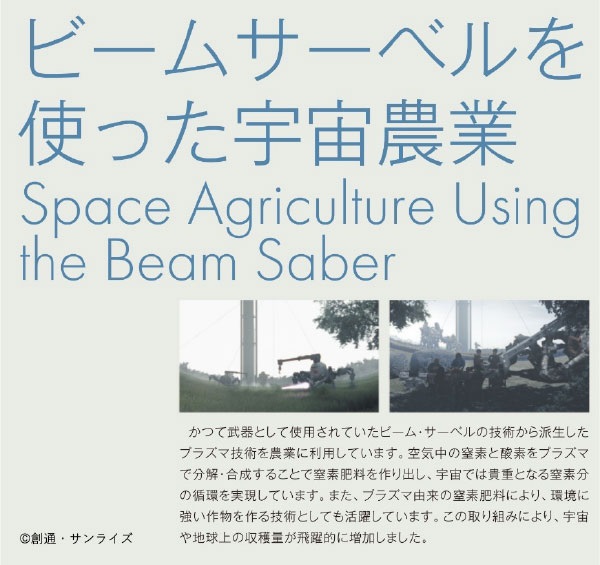
According to Kaneko, plasma technology can be further applied to agriculture in space. Specifically, he explains that, if scientists could create plasma-generating devices on the Moon, it would significantly reduce potential costs that would go into transporting actual fertilizer from Earth. During the last year’s Osaka Expo, Kaneko’s research on lunar plasma agriculture, titled Space Agriculture Using the Beam Saber, was showcased as part of the Gundam Next Future Pavilion.
Related articles:

Đorđe P
Articles: 510Related Posts