


Japanese e-book distributor and publisher BookLive recently conducted a manga analysis based on title and purchase data (source: GameBiz). The study examined how the titles of manga have changed in content and length over the years, as well as purchasing behavior, the diversification of reading habits, and the relationship between these three variables.
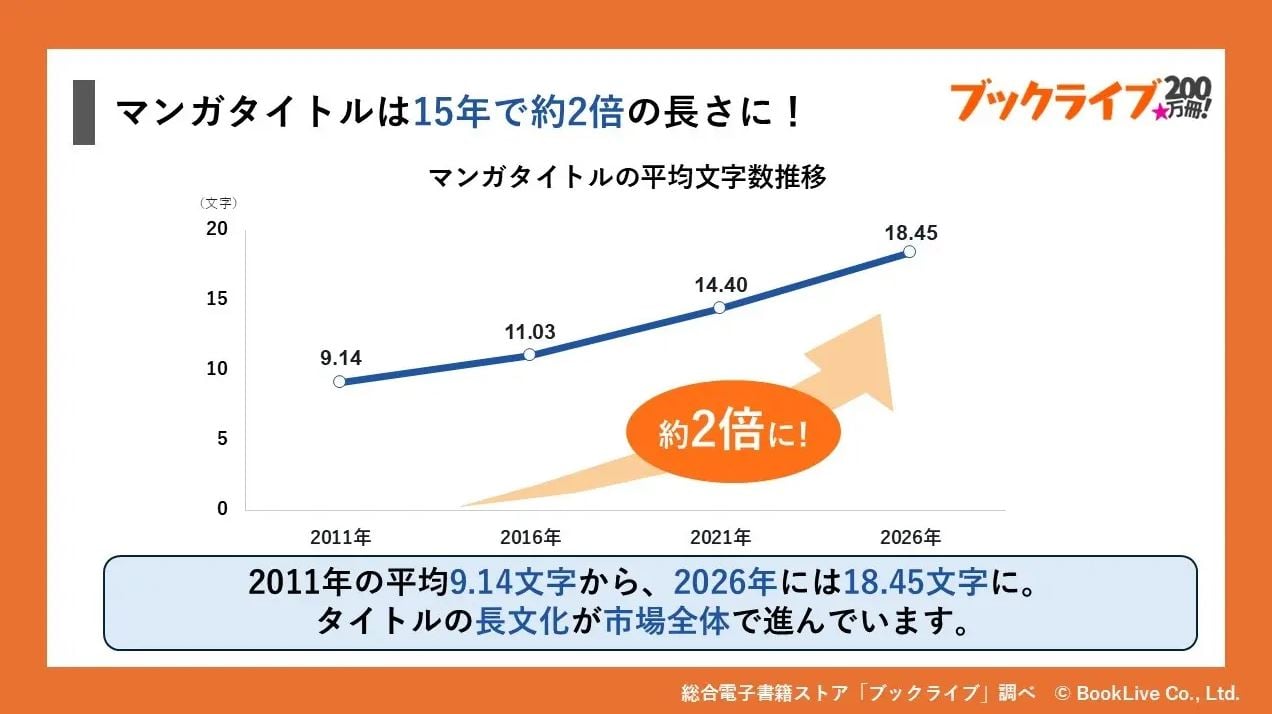
It was discovered that manga titles now are roughly two times longer than they were 15 years ago. Not only did the average number of Japanese characters in the title of a manga’s first volume jump from 9.14 in 2011 to 18.45 in 2026, but the median also increased from 8 to 16 characters in the same years. When classified by gender, current titles aimed at men average about 17.11 characters, while those aimed at women average 19.46 characters.
The trend toward longer titles was attributed to an increasing number of readers who prioritize efficiency of time and cost-effectiveness. Longer titles have a greater tendency to be more descriptive, thereby lessening the chance that prospective readers might be disappointed with the content after buying them. These “synopsis-style” titles, which were driven by the popularity of web novels, now serve as tags that can easily be entered into an e-bookstore search engine.
The words used in manga titles have also changed over the years. Shonen and seinen works with “alternate world/isekai,” “reincarnation,” and “strongest” in their names have frequently gone on to become bestsellers, along with the growing trend to showcase the world-building and protagonist’s abilities in the title.
Shojo and women’s manga titles have seen more of an evolution. Manga titles which included romance-centered words like “love,” “marriage,” and “romance” were prevalent in 2016, followed by realistic (some would say “drama-based”) titles with the words “housewife,” “exploitative workplace,” and “neighborhood” in 2019. Since 2021, isekai-associated words such as “young lady,” “villain,” “doting love,” and “saint” have gone to dominate BookLive’s top sellers list.
On the topic of top sellers, many readers were found to read titles outside of the bestsellers list. BookLive’s top 100 best-selling titles only accounted for 15.3% of its total sales over the past year, with titles outside of the top 100 accounting for roughly 85%. Additionally, 42.9% of readers did not purchase a single book from the top 100, indicating a majority shift to non-bestsellers.
Bulk purchasing has also increased over the years, with the average number of books purchased per transaction increasing from 1.19 in 2011 to 2.82 in 2026. The average total purchase amount also increased from 567 JPY ($ 3.60 USD) to 1,327 JPY ($ 8.43 USD). Both statistics were observed across several demographics, suggesting that e-books and promotional sales have led buyers to purchase and read completed series all at once.




This trend is really cursed.