Study of best-selling genres on Steam shows sandbox games continue to stand out in revenue
On the other hand, the report found that platformers tend to generate relatively low revenue overall.

Totally Human Media’s Steam discovery platform We Love It published its Steam Revenue Report on August 20. Based on data from around 100,000 Steam titles, the report analyzes revenue trends across different game genres. While commercial performance varied considerably by genre, sandbox games stood out for consistently producing strong selling games.
One important thing to note is that the report’s revenue figures are based on estimates, not actual sales data. The researchers use the Boxleiter method, which estimates revenue based on the number of reviews, a multiplier, and the game’s price. The report provides conservative (20x), standard (35x), and optimistic (50x) estimates. In this article, we’ll primarily refer to the standard 35x estimate.
Free-to-play games and titles that were no longer on sale and therefore had no available price were excluded. Games with zero reviews were also omitted, since reviews are required for the calculation. DLC was excluded as well, with the analysis limited to products categorized as “games” on Steam. Adult games were also excluded, and price changes over time were not taken into account.
The report covers approximately 100,000 games, with an estimated combined revenue of $129.8 billion USD. Among its various analyses, the breakdown of revenue by genre is particularly interesting. Genres are identified based on whether they appear among a game’s top six most popular Steam tags. This means that a game can be counted in multiple genres (for example, a roguelike FPS would be included in the tallies for both the roguelike and FPS categories).
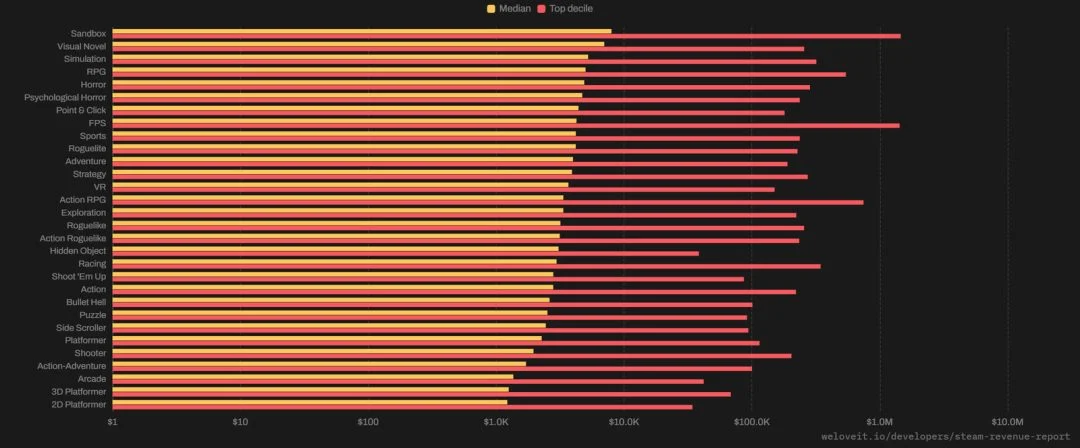
Image Credit: WeLoveIt.io
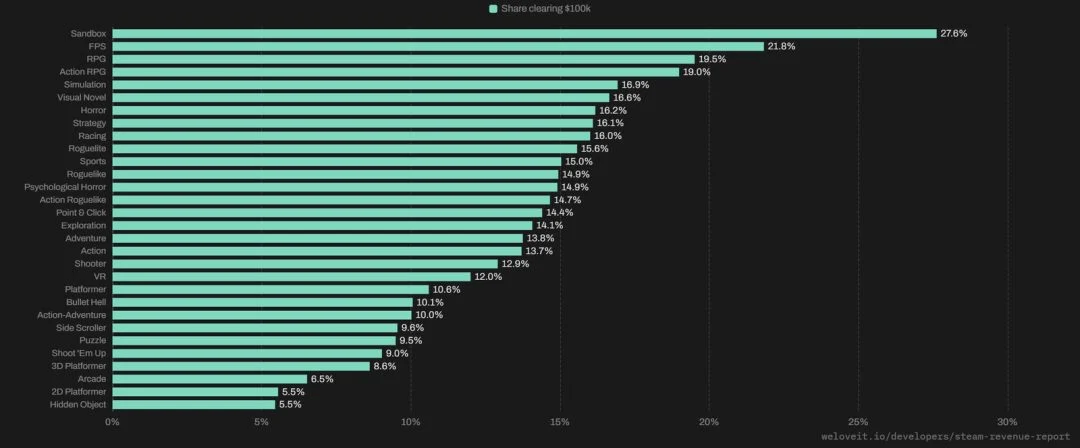
Image Credit: WeLoveIt.io
The report’s “Genre Economics” section compares the median estimated revenue, top decile revenue, and “hit rate” (the percentage of titles generating at least $100,000 in estimated lifetime revenue) for 30 major genres across the entire period analyzed. Among them, the sandbox genre stood out. It has both a high median revenue and a high-top decile revenue, while the hit rate is notably high at 27.4%, making this arguably Steam’s most consistently successful genre.
The genres with the next-highest median revenues were visual novels, simulation games, RPGs, horror, and point-and-click games. Meanwhile, in terms of top decile revenue, FPS games perform almost as well as sandbox titles, followed by action RPGs, RPGs, and racing games. This suggests that the genres producing the biggest individual hits are somewhat different from those with the strongest overall median performance.
On the other hand, platformer-related genres were on the lower end of the spectrum. Although the category accounts for major releases such as Sonic and Celeste, the report found that platformers tend to generate relatively low revenue overall.
The report also examines when different genres performed best. In the “When Each Genre Peaked” analysis, each genre’s median estimated revenue is compared with the median revenue across all games. A value above 1 indicates that the genre outperformed the overall market that year, while a value below 1 indicates underperformance.
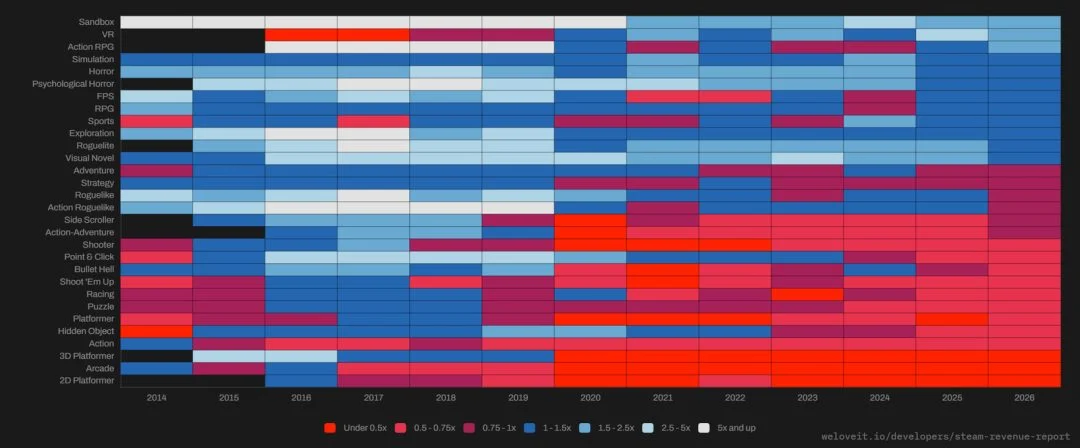
Image Credit: WeLoveIt.io
One notable trend here was that, since around 2020, there have been fewer genres achieving revenues of more than five times the overall median. At the same time, more genres have fallen below the overall median. The “Crowding vs. Payoff” analysis similarly suggests that the revenue gap between genres has gradually narrowed.
When it comes to sandbox games, they were especially dominant during the 2010s, with their median revenue in 2017 reaching roughly 15 times the overall market median. Roguelikes appear to have peaked around 2017, and although they remain successful, their revenue performance in recent years is no longer as far above the market average as it was then. Horror, visual novels, and RPGs have also generally maintained slightly above-average revenue. FPS games have produced highly successful individual titles overall, but the genre appears to have gone through a relative downturn in the first half of the 2020s. Platformers have continued to struggle, particularly since 2020, when their performance fell significantly below the overall market median.
That said, the findings should still be treated with caution, since the revenue figures are estimates rather than actual sales figures. The number of releases also varies significantly between genres, meaning that revenue may be spread across a larger number of titles in some categories. Even so, the report provides an interesting picture of which genres tend to perform well on Steam and how that has changed over time. Naturally, as the market changes, the earning potential of different genres is bound to change too. The report also includes analyses of other factors, such as revenue by price range, so for developers looking to create commercially successful games, it might offer useful insights.

Genki Hashimoto
Articles: 3Related Posts