The Japan Fair Trade Commission (JFTC) and the Cabinet Office’s Intellectual Property Strategy Headquarters announced a new set of guidelines for ensuring fair transactions for creators in anime and film production on June 22. As reported by Game Biz, these guidelines call for clear disclosure of contract terms, fair compensation, as well as the allocation of costs for additional work. This is likely to address the many issues that exist between production companies and their subcontractors. And while this sounds like good news for freelance anime creators, especially considering the industry’s infamously poor working conditions and the fact that they are not protected under current labor laws, JFTC’s campaign for promoting the new guidelines has been facing heavy backlash.
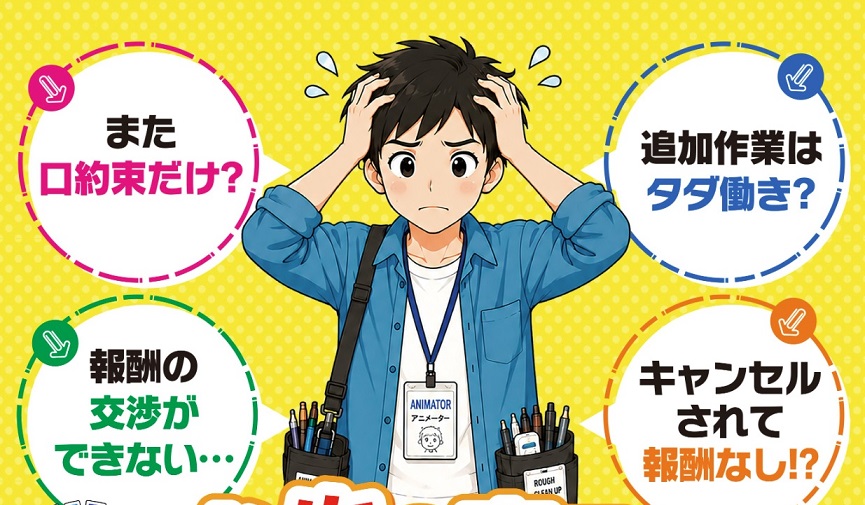
On the day of the announcement, the JFTC published informational pamphlets meant to spread awareness about the new guidelines. However, the campaign was heavily criticized by Japanese creatives on X, due to the pamphlets featuring what appear to be AI-generated illustrations. Many called the move “ironic,” specifically because a government organization presumably published the pamphlets to support independent creators without getting actual artists on board to create the illustrations. Furthermore, the fact that the AI-generated assets feature “inconsistent” designs, including unnatural depictions of tools commonly used among animators (the upside-down drawing tablets, for example), has only added fuel to the fire.
The fact that they settled for generative AI instead of hiring actual creators to promote policies like this really makes you realize why the Cool Japan strategy never quite succeeded.
These illustrations really show how “high-quality” the Fair Trade Commission’s approach to anime production is.
Why didn’t you commission an animator to make this?
Even though it’s supposed to be a poster to support creators, it’s so twisted that they used generative AI for it, lmao. You can really tell that these guys don’t understand anything.
In response to an inquiry made by Japanese news outlet ITMedia, the JFTC stated that the pamphlet was commissioned from a certain production company, but that the actual work was done by an illustrator belonging to a firm that had been subcontracted by the said production company. Apparently, the illustrator used AI to generate images for the pamphlet, which were “later edited for the final design.” As the JFTC official confirmed from the subcontractors, the reason behind AI use was to “improve efficiency of creating the materials.”
When commissioning the pamphlet, the JFTC did not prohibit the use of generative AI in the contract specifications. However, the production company in question was required to confirm that the materials they had generated did not infringe on any copyrights.
Regarding the design inconsistencies themselves, the JFTC official stated that, while the Commission did review the final product, since their investigation mostly focused on business practices within the industry, they didn’t have sufficient expertise regarding the finer details like tools used on set.
The JFTC said that it is aware of the reactions on social media, and that it intends to take appropriate action when it comes to future campaigns. However, it declined to comment on whether it would delete or replace the problematic images.
Related articles: