
Hiraku Agent published a report on September 16 examining how the adoption of AI technology has influenced the Japanese game industry when it comes to in-demand skills and job positions. The report is based on a 2026 survey of around 1,008 men and women working in recruitment roles in the domestic game industry, and it compares results to that of a similar survey conducted in 2024.
When asked what they believe game industry employers look for most when hiring, respondents in the 2026 survey most commonly cited “previous experience and skills” at 32.9%, followed by “ability and willingness to adapt to and learn new technologies such as AI” at 30.8%, and “understanding of the company’s own games” at 27.9%.
These results differ from Hiraku Agent’s 2024 survey, in which the top three responses were “previous experience and skills” at 35.1%, followed by “favorite game genres” at 26.3% and “communication skills” at 25.1%. The report surmises that a candidate’s attitude and skills related to AI have become a significantly more important factor for companies. When asked how much candidates’ AI skills, including experience using generative AI, are valued in recent game industry hiring, 34.1% of respondents said they are “highly important,” while 57.0% said they are “somewhat important.”
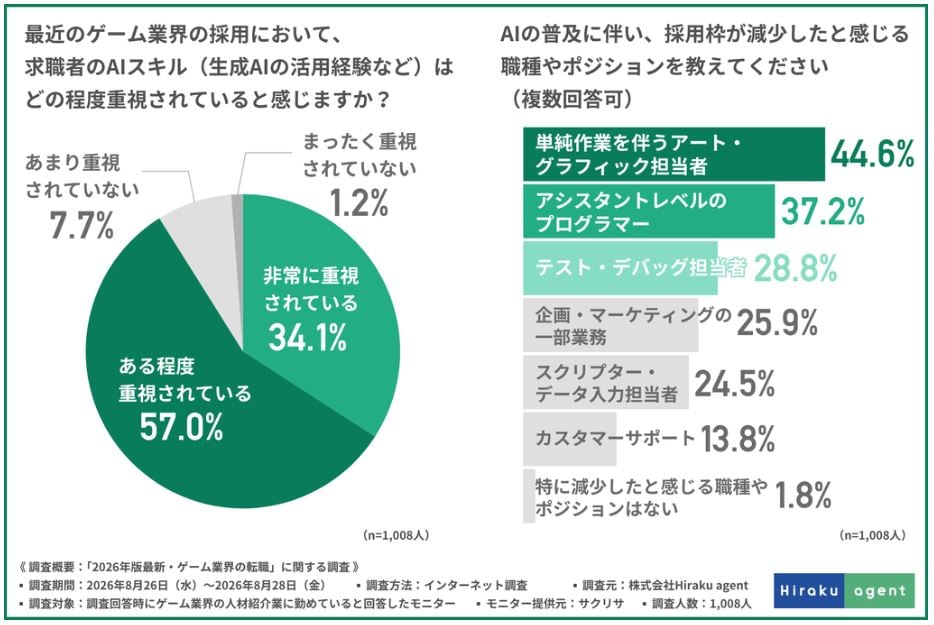
Of note, when it comes to game dev job positions that have seen a decrease in openings as a result of AI becoming widespread, recruiters cited “art and graphics positions involving simpler tasks such as background and prop creation” as the top answer (44.6%), followed by “assistant-level programmers” (37.2%) and “testing and debugging staff” (28.8%). Hiraku Agent suggests that demand may be declining for work that has traditionally been handled by younger or less-experienced creators, including tasks which can be performed according to established rules (thus becoming AI-assisted or even automated). The agency believes that game dev candidates with less experience may increasingly be required to demonstrate specialized expertise or additional value beyond “basic” production tasks, potentially making entry into the industry more difficult.
On the flip side, the survey found that recruiters see a growing demand among employers for positions capable of making effective use of AI. The most commonly cited role was “high-level art directors capable of correcting and directing generative AI output,” at 45.9%. This was followed by “AI engineers and technical artists capable of integrating AI into development environments and pipelines” at 44.1%, and “creators capable of using AI tools to rapidly produce deliverables” at 34.6%.
On a related note, CESA, the organizer of Tokyo Game Show, recently published the 2026 results of its annual video game industry report, which found that over 85% of Japanese game developers use generative AI, marking a significant increase from last year’s 51%.