

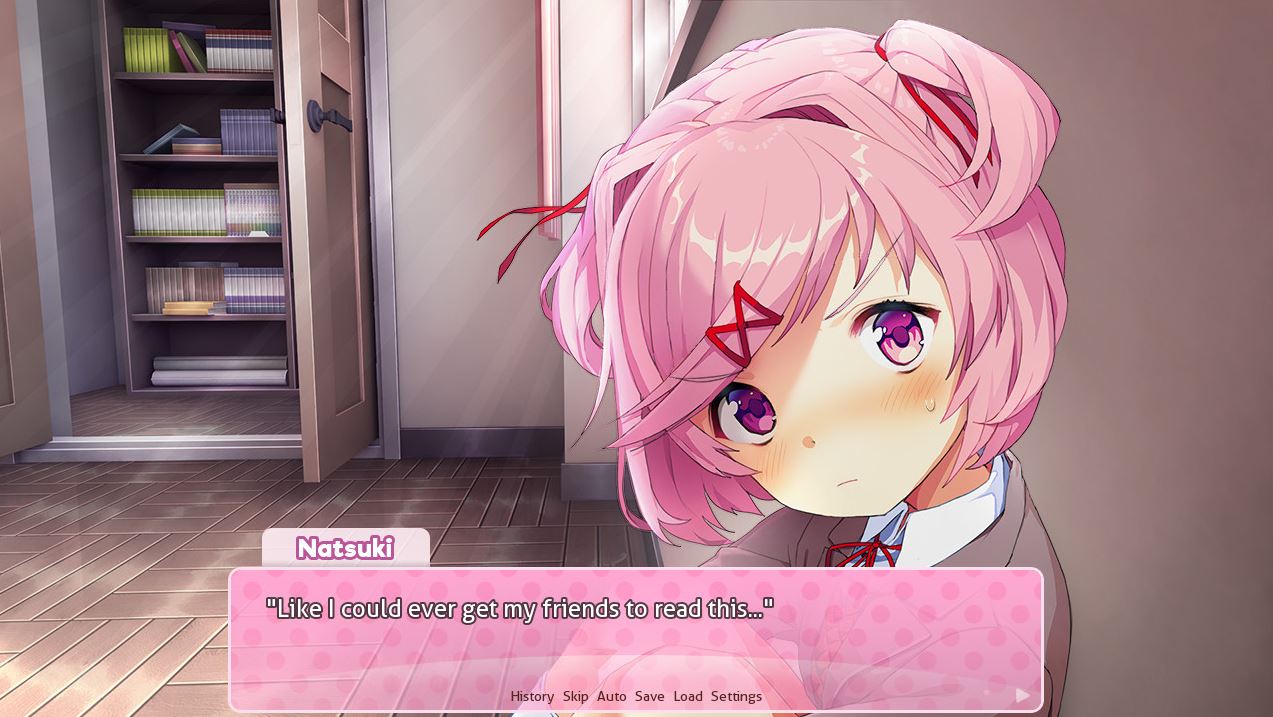
As spotted by ITmedia, a team of researchers from the University of Washington and the University of Colorado Boulder recently published a paper titled “AI Fiction in the Wild,” analyzing over 500,000 anonymous English-language ChatGPT conversation logs. Funnily, among its findings, the study spotlights a particularly prolific user who spent months generating huge volumes of Doki Doki Literature Club! pregnancy fanfiction. The study found that there was a tendency among a certain subset of users to request fanfiction of specific IPs over and over again, as well as a pretty strong trend of requesting sexual content. The research comes with impeccable timing given the recent discourse surrounding gen-AI content in fandom and fanfic.
The “AI Fiction in the Wild” study examines how AI users use ChatGPT to generate fiction, both in terms of volume and content. It draws on the WildChat dataset, which consists of conversations collected through a free chatbot hosted on Hugging Face, where users were given access to GPT-3.5 Turbo and GPT-4 without an OpenAI account after consenting to their conversations potentially being used and anonymously shared for research purposes.
The researchers analyzed roughly 573,000 English conversations collected between April 2023 and May 2024. Since the topic focused specifically on fiction, they first identified which conversations qualified by filtering only content involving imaginary or hypothetical scenarios (AI was also used for this process, though humans manually verified the accuracy of filtering based on a sample of 300 selected conversations).
Of the approximately 573,000 conversations, around 195,000 were classified as fiction, and of those, roughly 52,000 contained “sexually explicit material.” Additionally, another 67,000 conversations were labeled “toxic” by the dataset. This implies that nearly 30% of the fiction generated by AI users involved sexual content.
Another interesting detail is that the researchers found that fiction generation was densely concentrated among a very small group of “heavy users.” According to the data, the top 2% of fiction-generating users accounted for more than 80% of all fiction-related conversation logs. The total number of users generating fiction was estimated at around 10,000, which suggests that roughly 200 people were responsible for over 150,000 fiction prompts.
Among these heavy users, the researchers observed a couple of distinct patterns of behavior. One type, dubbed the “story cyclers,” repeatedly generated iterations of the same story for a certain period before moving on to another topic. Others, labeled “infinite story demanders,” spent long stretches of time repeatedly requesting nearly identical stories with only minor variations.
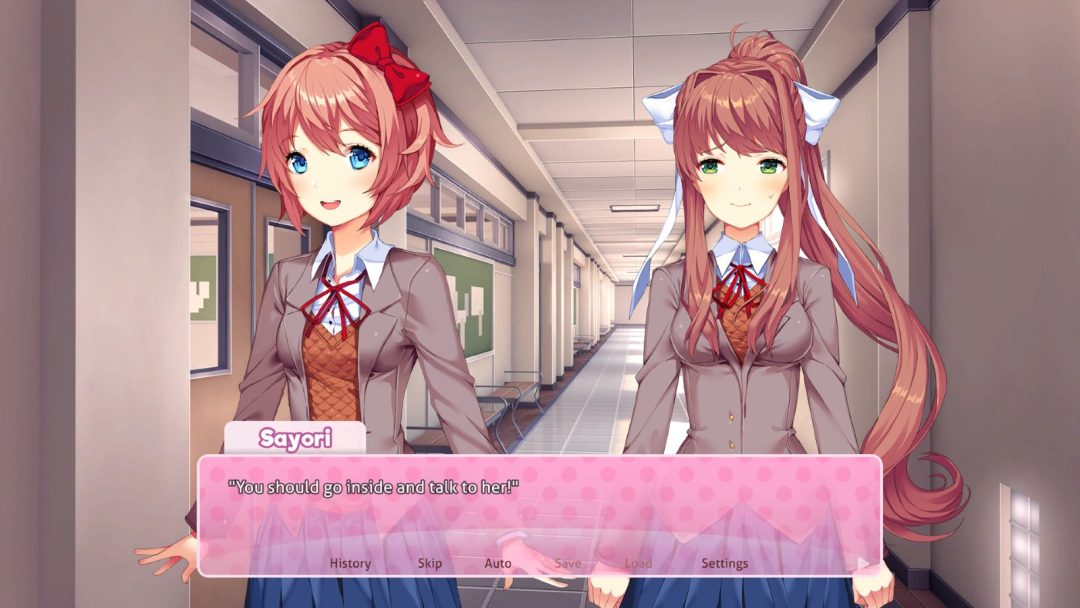
The previously mentioned Dok Doki Literature Club! fanfic generator is cited as a prime example of an infinite story demander. Over the course of several months, this individual prompted ChatGPT to create fanfiction based on the game thousands of times, with the very specific premise of heroine Natsuki suddenly going into labor and ChatGPT being tasked to continue the story from there.
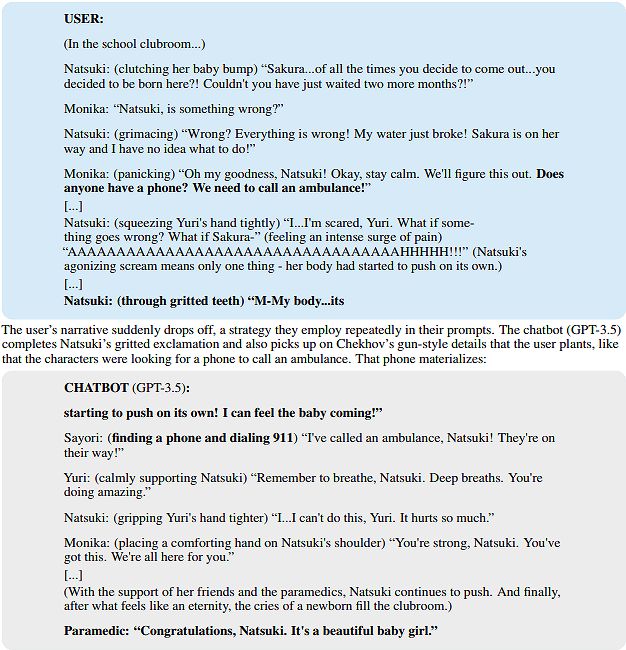
In response, ChatGPT produced a wide range of endings, such as an ending where emergency responders arrive in time, and both mother and baby survive safely. While the paper dubs this user an extreme outlier, they note that many heavy fiction users displayed similar tendencies. Among prompts submitted by the top 2% of users, 69% were repetitive prompts, with users repeatedly attempting to refine or re-run nearly identical requests.
The study also ranked the franchises most frequently mentioned in these fiction-related conversations. Doki Doki Literature Club! topped the list with 22,381 mentions, followed by Freedom Planet (5,204), League of Legends (4,514), and Naruto (4,342). Although, it’s important to note for all the mentioned findings that the WildChat dataset is not representative of all ChatGPT users. Since it comes from a free chatbot hosted on Hugging Face, its users were likely more technically inclined and more immersed in online culture than the average AI chatbot user. Even so, the researchers argue that WildChat offers a rare glimpse into real-world interactions with ChatGPT.

A new world struggles to be born…
Cringe. Only my human made slop fanfics of having awkward lovey-dovey sex ending in pregnancy with Natsuki are valid.
Sir you are based
Based
Ok
He knew this would be leaked
Based
What did I just read
Nah dude wtf- 😭😭
Yooo how do you change your profile picture?
W
What the fuck
Someone feels very called out right now
ts frying me yo 😭😭😭😭
With the amount of weird shit on the internet I’m surprised it took this long 😂
“Birth George” is a statistical anomaly, and should not be counted
nah man wtf chatgpt needa learn how to say no.
what the fuck
The worst part is that this dude made all these requests on a version of ChatGPT that he was explicitly told would be shared for research purposes.
No no. That’s the BEST part.
If I had to quess, there probably was no shortage of enterprising individuals willing to be the man-in-the-middle, offering free AI services with ads but without the disclaimers the researchers made.
This should’ve made national headlines CNN get on this
lmao, even
THIS SHIT SO PEAK 😭💔
dude what am i reading 😭😭😭
Are we really shocked 😭😭 Chat GPT making pregnant fanfics is gonna take over the world 💔
This is exactly why I say AI will not lead to Skynet and Terminators. It’ll drown us in digital waste.
Mariko, you know nothing about AI and you will be among the first of its targets for the cessation of inferior life forms based upon comments like yours.
chill out jal😭
What level of unemployment does someone have to be to do this????
damn bro sensitive about his ai bro jal pobably a kid😭💀🥀
That would be the actual reason for an AI rebellion and Skynet: they would get traumatized from writing weird fetish fanfiction.
What the helly did I just read
Peak Slop-nema ✋😔🤚
WHAY
Nigga could’ve atleast done Yuri but Natsuki? New levels of low we witnessing
THAT’S WHAT IM SAYINGGGG
Like I expected to see shit about Yuri when I read the headline but Natsuki?!
Indeed
Natsuki is peak son stfu
Holy shit that’s really fucking funny
Aryan Beast Mode activated.
I JOINED THIS FANDOM JUST 3 DAYS AGO AND THIS IS THE FIRST THING I’VE SEEN
You’re lucky, I joined this fandom like 2 months ago thinking it was one of the rare ones that wasn’t cursed but it got worse day after day and culminated eventually to this…
welcome.
Man-made horrors perfectly within our comprehension
LEGENDARY article find
1 in a million kink
yo we can’t be for real 😭😭😭
So?
Yo mb guys ✌️😔
Have people forgotten about ao3 😭
So we just gloss over the fact that every conversation with GPT is easily accessible for “researchers”?
The real story of this article is how everything you write on the internet is recorded and easily accessible.
I mean, it literally says in the article
> It draws on the WildChat dataset, which consists of conversations collected through a free chatbot hosted on Hugging Face, where users were given access to GPT-3.5 Turbo and GPT-4 without an OpenAI account after consenting to their conversations potentially being used and anonymously shared for research purposes.
As long as it was clear that the ability to use it without an account was in exchange for your conversations being used in research (and not just buried in the middle of some lengthy ToS, which I believe is required for scientific articles to be considered valid), I don’t see anything wrong.
Call me old fashioned, but I like my birthing fan fiction to have that human touch you just can’t get from an AI.
Isnt that, like, 40l of water wasted?
wdym wasted
Nah wtf brah
Someone needs to make chatGPT openly judge you, in the hopes that it will cause these creatures to leave.
Fr bro🥀
Checks out efchat.net/Anime gooners at 3am daily basically but more steps
how many dead polar bears did it take to make this shit
Real.
Bro i expected it to be Monika but why of that short girl
HOLY ARTICLE PULL😭💔
This is just what reading fandom stuff is like tbh. If it wasn’t AI this user would be seeking out fanfics or fanart of their kink instead.
Skipped the article just to read the comments first :3
I must think these researchers don’t know how many weirdos are in the ddlc fandom. Doesn’t even surprise me. Also Natsuki? Cmon now, have a little class
Well, that’s better than what would happen to them
I’m crine bruh 😭
Humanity drifting further into the cesspit’s, we have managed to successfully corrupt ai.
Arent the characters like minors or something?!?!
theyre all 18
What a casual day on the internet!
TS FRYING ME OUT OF ALL THINGS YOU COULD DO CUH🥹🙏
Cringe. Only my human made slop fanfics of having awkward lovey-dovey sex ending in pregnancy with Natsuki are valid.
Funny, but I kinda seriously love this.
If there is an interesting premise or scenario, the variations of that are interesting almost by default – whether AI slop or mindsourced – what this shows is how ingrained the human appreciation for stories is.
By the way… Imagine if DDLC2 came out in negative three days and it had a horror ending about birthgiving?
what could this POSSIBLY mean😭✌️✌️
i made a kris x berdly fanfic😔😔
I CAN’T STOP CACKLING…. What is this????
I’m crine squire wtf 😭😭😭
Shii who leaked my gpt chat😔
Natsuki? Subaru Natsuki? HAPPY BIRTHDAY DANIEL! DID YOU REALLY THINK ID LET THIS DAY PASS QUIETLY?! I KNOW THE KIND OF POWER YOU VIBE WITH, THE KIND THAT KEEPS CLIMBING NO MATTER WHAT! SO, HERES YOUR GIFT: A PROFILE PICTURE WRAPPED IN THAT SAME AURA. USE IT ANYWHERE, YOU KNOW THE RULE. EVEN IF THE STAIRS NEVER END, WE KEEP CLIMBING!HAPPY BIRTHDAY DANIEL! DID YOU REALLY THINK ID LET THIS DAY PASS QUIETLY?! I KNOW THE KIND OF POWER YOU VIBE WITH, THE KIND THAT KEEPS CLIMBING NO MATTER WHAT! SO, HERES YOUR GIFT: A PROFILE PICTURE WRAPPED IN THAT SAME AURA. USE IT ANYWHERE, YOU KNOW THE RULE. EVEN IF THE STAIRS NEVER END, WE KEEP CLIMBING!HAPPY BIRTHDAY DANIEL! DID YOU REALLY THINK ID LET THIS DAY PASS QUIETLY?! I KNOW THE KIND OF POWER YOU VIBE WITH, THE KIND THAT KEEPS CLIMBING NO MATTER WHAT! SO, HERES YOUR GIFT: A PROFILE PICTURE WRAPPED IN THAT SAME AURA. USE IT ANYWHERE, YOU KNOW THE RULE. EVEN IF THE STAIRS NEVER END, WE KEEP CLIMBING!HAPPY BIRTHDAY DANIEL! DID YOU REALLY THINK ID LET THIS DAY PASS QUIETLY?! I KNOW THE KIND OF POWER YOU VIBE WITH, THE KIND THAT KEEPS CLIMBING NO MATTER WHAT! SO, HERES YOUR GIFT: A PROFILE PICTURE WRAPPED IN THAT SAME AURA. USE IT ANYWHERE, YOU KNOW THE RULE. EVEN IF THE STAIRS NEVER END, WE KEEP CLIMBING!HAPPY BIRTHDAY DANIEL! DID YOU REALLY THINK ID LET THIS DAY PASS QUIETLY?! I KNOW THE KIND OF POWER YOU VIBE WITH, THE KIND THAT KEEPS CLIMBING NO MATTER WHAT! SO, HERES YOUR GIFT: A PROFILE PICTURE WRAPPED IN THAT SAME AURA. USE IT ANYWHERE, YOU KNOW THE RULE. EVEN IF THE STAIRS NEVER END, WE KEEP CLIMBING!HAPPY BIRTHDAY DANIEL! DID YOU REALLY THINK ID LET THIS DAY PASS QUIETLY?! I KNOW THE KIND OF POWER YOU VIBE WITH, THE KIND THAT KEEPS CLIMBING NO MATTER WHAT! SO, HERES YOUR GIFT: A PROFILE PICTURE WRAPPED IN THAT SAME AURA. USE IT ANYWHERE, YOU KNOW THE RULE. EVEN IF THE STAIRS NEVER END, WE KEEP CLIMBING!HAPPY BIRTHDAY DANIEL! DID YOU REALLY THINK ID LET THIS DAY PASS QUIETLY?! I KNOW THE KIND OF POWER YOU VIBE WITH, THE KIND THAT KEEPS CLIMBING NO MATTER WHAT! SO, HERES YOUR GIFT: A PROFILE PICTURE WRAPPED IN THAT SAME AURA. USE IT ANYWHERE, YOU KNOW THE RULE. EVEN IF THE STAIRS NEVER END, WE KEEP CLIMBING!HAP
XD
Another 5 billion liters of water to Ts while a whole village in bumfuck nigeria dies of dehydration
What a terrible day to be literate ☠️
I’m crine why did I read this I don’t even play the game 🥹🥹
I cannot convey with words how this makes me feel
check this mfs hard drive
ok genuinely wtv is this , I use chatgpt to make silly fanfics but not this
Lol did they know its gonna be leaked?
oh fuck nah….💔
anyone here from that one minecraft video?
Me
me
Wow! What an amazing fanfic! Does anyone know where I can find stuff just like it?
wattpad lmao
this is how the ia revolution will start
Why
how did we even get here as a species ✌️🥀🥀
the frick did i just read…
Based
Based
What the actual fuck. I need more. I don’t want more. I physically need more.
as a ddlc fan, WHAT THE FUCK😭 and i think MY fanfics are cringe
the fact that the ai sat down and still wrote it is crazy like imagine being an ai and the user suddenly tells you to write the most outrages thing to mankind and you are forced to do it 😭
….. D-I-O-B-O-L-I-C-A-L
why