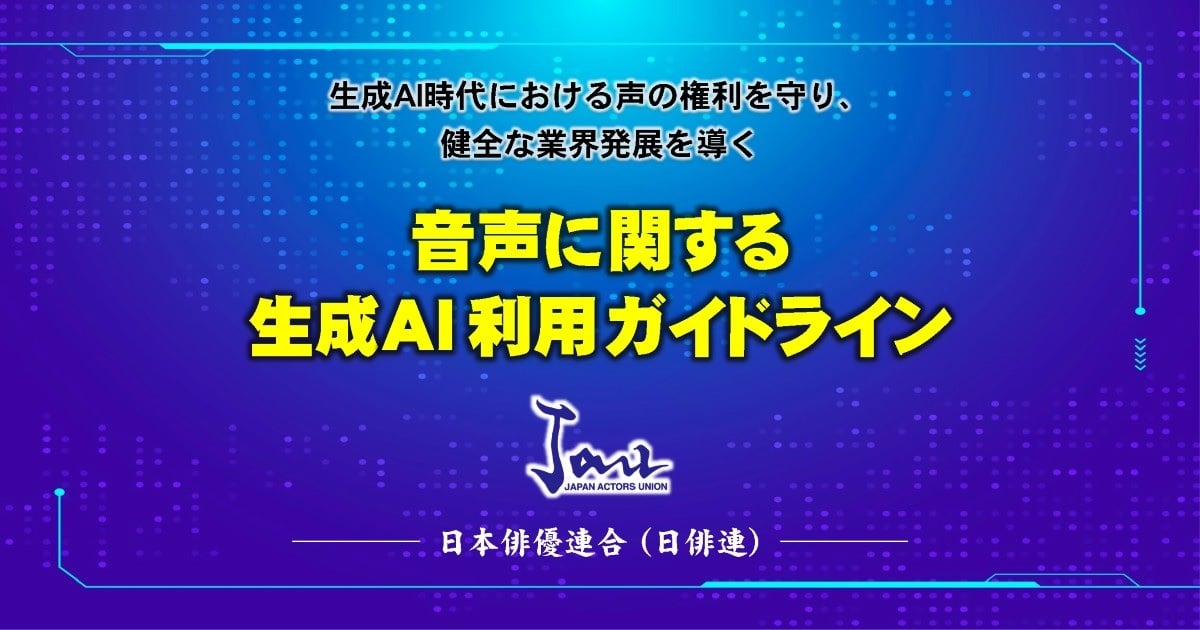
The Japan Actors Union officially announced a new set of guidelines regarding the unauthorized use of generative AI for voices on October 16. The guidelines are intended to protect the rights of actors and other performing artists, while also serving as a framework for AI-related businesses to conduct their activities safely. The guidelines tackle topics such as the handling of permissions and royalties, as well as the ethical issue of copying voices of deceased actors.
This comes after a series of cases in recent years involving the unauthorized use of celebrities’ voices and likeness in AI-generated videos and images, with one of the most impactful examples being veteran voice actor Kenjiro Tsuda’s lawsuit over a TikTok account featuring videos that imitated his voice using generative AI.
As there are no laws in Japan that directly protect voice rights, The Japan Actors Union and other organizations representing performing artists have been continuously pushing for legal reforms in wake of the issue. While Japan’s Ministry of Justice and Ministry of Economy, Trade and Industry have previously drafted guidelines stating that voices may also be subject to protection under “publicity rights” and the Unfair Competition Prevention Act, The Japan Actors Union’s wider set of rules have likely been made to further push the government towards fully legalizing “voice rights.”
The new guidelines by The Japan Actors Union tackle four key issues.
Firstly, the guidelines call for obtaining prior consent at “every stage” of the generative AI process, which includes training (input), generation, and publication/use (output). It will be mandatory for AI companies to clearly state their purpose and obtain permission from the person whose voice they want to use in AI training. This will allow voice actors and other performers to have control over when, where and how their voices are used.
Additionally, the use of AI-generated voices will be defined as a new form of “performance,” which means that companies will have to pay appropriate compensation or royalties to actors. According to The Japan Actors Union, this ensures that AI will become a tool that allows actors to “license their own voices and generate revenue,” rather than being seen as “a job-stealing threat.”
When it comes to automatic translations (AI-generated audios that mimic an actor’s voice in another language), the guidelines protect the artistic integrity of the original performance, and guard actors against unauthorized use in overseas regions. In the case of content getting multi-language translations, actors are guaranteed the right to obtain new usage licenses and additional compensation to account for global distribution.
Interestingly, the guidelines also touch on the topic of AI-generated “clones” that replicate the voices of deceased actors, which is also one of the big ethical issues caused by the rapid proliferation of AI technology. According to the Japan Actors Union, the new guidelines protect the dignity, reputation and legacy of deceased actors from commercial exploitation. Therefore, companies will be banned from using deceased actors’ voices for AI, with the exception of projects that the deceased had agreed to participate in during their lifetime. Even with this exception, companies will have to obtain prior written consent from the deceased’s bereaved family members, as well as the agency or organization with which the deceased was affiliated, and pay them royalties.
“The Japan Actors Union will strive to not just establish these guidelines as industry-wide rules, but also strengthen its efforts to encourage the government to legislate regulations that protect ‘voice rights.’ Technological advancements will not stop, but the ‘living, breathing human expression’ and a ‘respect for rights’ must always remain at its core,” the Japan Actors Union wrote.
Related: