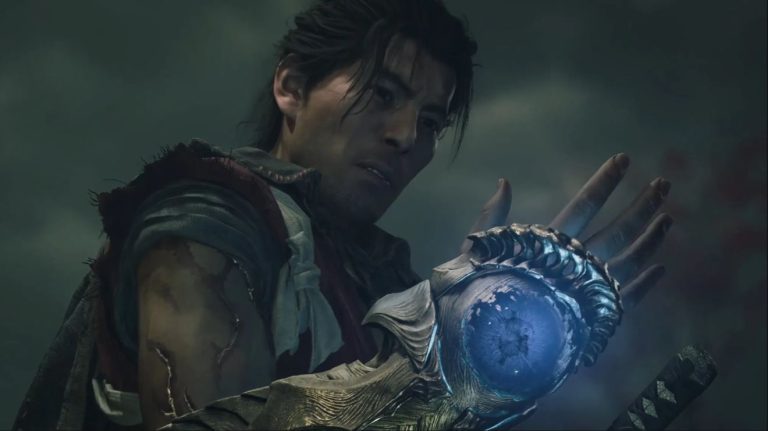

Over the last week, I had the opportunity to sit down with a copy of Bushiroad and Cherrymochi’s Dusk Index: Gion, a suspense visual novel that released in January of this year. After playing through five of the game’s thirteen chapters, I can certainly say that it has left a memorable impression on me and got me thinking about where the current state of technology is driving us as a society.
The game follows a linear narrative in which player interaction consists almost entirely of reading and advancing through text, with no branching paths or puzzles to be found. It features a plot that plays out similarly to other Japanese mystery games of recent years, bringing to mind AI: The Somnium Files and the Paranormasight duology to name a few. Murder is the name of the game, with players following a pair of detectives as their investigations lead them down winding roads full of unforeseen twists and thought-provoking conundrums, all with a healthy dash of humor to alleviate the gruesome subject matter.
The plot of Dusk Index: Gion follows a dual narrative surrounding two strings of unusual murders occurring in Kyoto, one in an alternate history version of the year 2006 in which artificial intelligence and augmented reality technology have infiltrated nearly every facet of everyday life, and another in 1906 during the tail end of Japan’s Meiji era, when the country was still adapting to the reopening of its borders and the fruits of the industrial revolution. Why the writers chose to go with the alternate history angle instead of simply setting the “modern day” sections of the game in the near future is anyone’s guess, but it’s one of a few ambiguous questions that players will just have to roll with.
The protagonist of the 2006 half is a young homicide detective named Daiki Katsuki who, despite his age, is at odds with the technologically-driven world which he inhabits. His opening monologue about his disdain for AI and AR tech struck me as something of a manifesto from the game’s writers; a thinly veiled critique of our own modern reality.
This is quickly complicated however, as shortly after being called to the scene of a murder he is tasked with effectively euthanizing the AI companion of the victim, which is personified as a cute looking golden retriever, now that its owner is no longer among the living. It’s a heartbreaking moment that felt reminiscent of something out of Naoki Urasawa’s Pluto, or even Osamu Tezuka’s original Astro Boy manga, both of which also dealt with the ethical complexities associated with man-made conscious beings. The sympathy afforded to an inorganic form of intelligence as its existence is snuffed out shows that Katsuki – and the game’s developers by extension – do not consider the ethical dilemmas imposed by AI to be as black-and-white as they may appear.
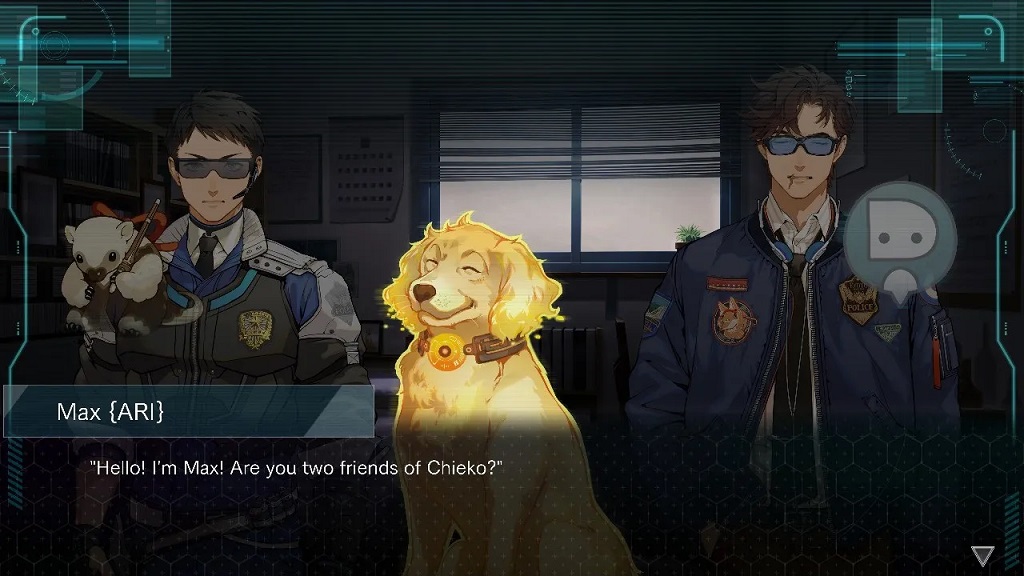
In the course of his investigation, Katsuki, accompanied by his own AI companion nicknamed Dee (an outdated model that he keeps on stock settings with a generic, speech bubble-like appearance) discovers that the mysterious circumstances of the murder – in which the victim was found surrounded by an occult-like ring pattern drawn on the floor in her own blood – eerily matches the description of a little-known murder case from a century prior. This brings the narrative back in time and opens up its other half.

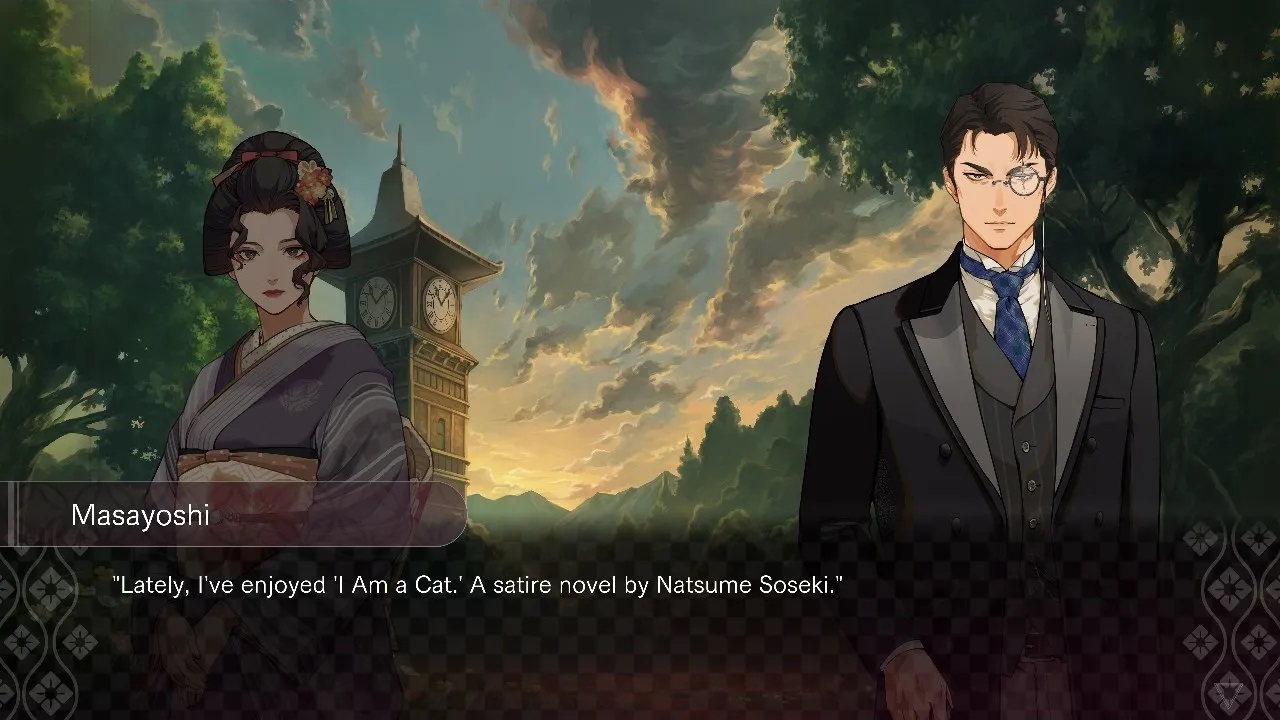
The 1906 portions of the game are shared in roughly equal parts by two lead characters: The one-eyed detective Masayoshi Nagahama, and the refined geisha Saki. The unlikely pair cross paths multiple times over the course of the game as a string of bizarre slayings characterized by the same occult symbol as the one seen in Katsuki’s time period terrorizes the streets of Gion, Kyoto’s famous geisha district.
While the 1906 episodes of the story obviously don’t feature any of the modern AI/AR tech that characterizes the 2006 side, they do tackle similar ethical concerns regarding the development of new technologies and how they impact people’s livelihoods. The late 19th to early 20th century saw a paradigm shift similar to the one that some believe is happening now, where many people were greatly disturbed by and even lost their livelihoods to new inventions like cameras, textile spinning machines, and various new forms of mass communication. The game intentionally juxtaposes these modern conveniences that many of us take for granted against the uncertain future of today’s cutting-edge technology, asking us to consider whether or not the potential long-term benefits of such advanced technologies justify any suffering that they may bring about as a side effect.
Back in 2006, following a second murder disturbingly similar to the first, complete with an occult symbol drawn in blood “matching” another 1906 case, Katsuki teams up with a young half-Japanese, half-American computer whiz named Rio Quinn whose technophilia makes her a perfect foil to Katsuki’s cautiously ambivalent personality. Together they make use of a newly launched augmented reality service dubbed Echoes of Kyoto that allows users to walk through a recreation of early 20th century Kyoto via AR projections beamed on top of the real, modern version of the city.
Without giving too much away, Katsuki and Rio use Echoes of Kyoto to trace Detective Nagahama’s footsteps as they struggle to make sense of the macabre killings, but each answer they find seems to only raise further questions. At the same time, they continue to struggle with the conflicts and troubles unique to living in a society where computers and digital spaces have almost completely overtaken any semblance of unplugged reality. Interested readers will have to play the game for themselves to see how it all ties together.

From a technical standpoint, Dusk Index: Gion largely succeeds given the simplicity of its design. The text is well written by and large, although the English translation does have its share of typos and odd punctuation. I also noticed a small handful of lines seemed oddly abbreviated from the Japanese script, where a character would audibly speak at length despite the corresponding English text being just a few words; although the basic sentiment of the original line was usually still intact.
The artwork has a “noir” flair that reminds me of the character art in the Paranormasight games, although with a slightly more colorful, pop sensibility. The soundtrack primarily consists of atmospheric tracks that emphasize the mood of each scene, and although I don’t see myself listening to it outside of the game, it serves its purpose well. While not every character is voiced, the main roles are performed by mostly veteran voice actors who all turn in commendable performances.
Ultimately, I came away from Dusk Index: Gion pleasantly surprised. While the opening scenes led me to expect a paranoid, didactic story about the evils of technology, the game quickly revealed a much more complex and nuanced narrative that I am eager to dive further into.
Dusk Index: Gion is available digitally now on PC via Steam, Nintendo Switch, and PlayStation 5, with a release on Xbox Series consoles forthcoming. A free demo is also available for the Steam and Nintendo Switch versions.
Related articles:
Hotel Dusk: Room 215 author’s new mystery visual novel Dark Auction is 10% off to commemorate launch