
Greetings, my name is Ollie Barder. I’m from the UK and work in the game industry as both a game designer and a journalist in Tokyo. My area of expertise is mecha games, having played them for over 30 years.
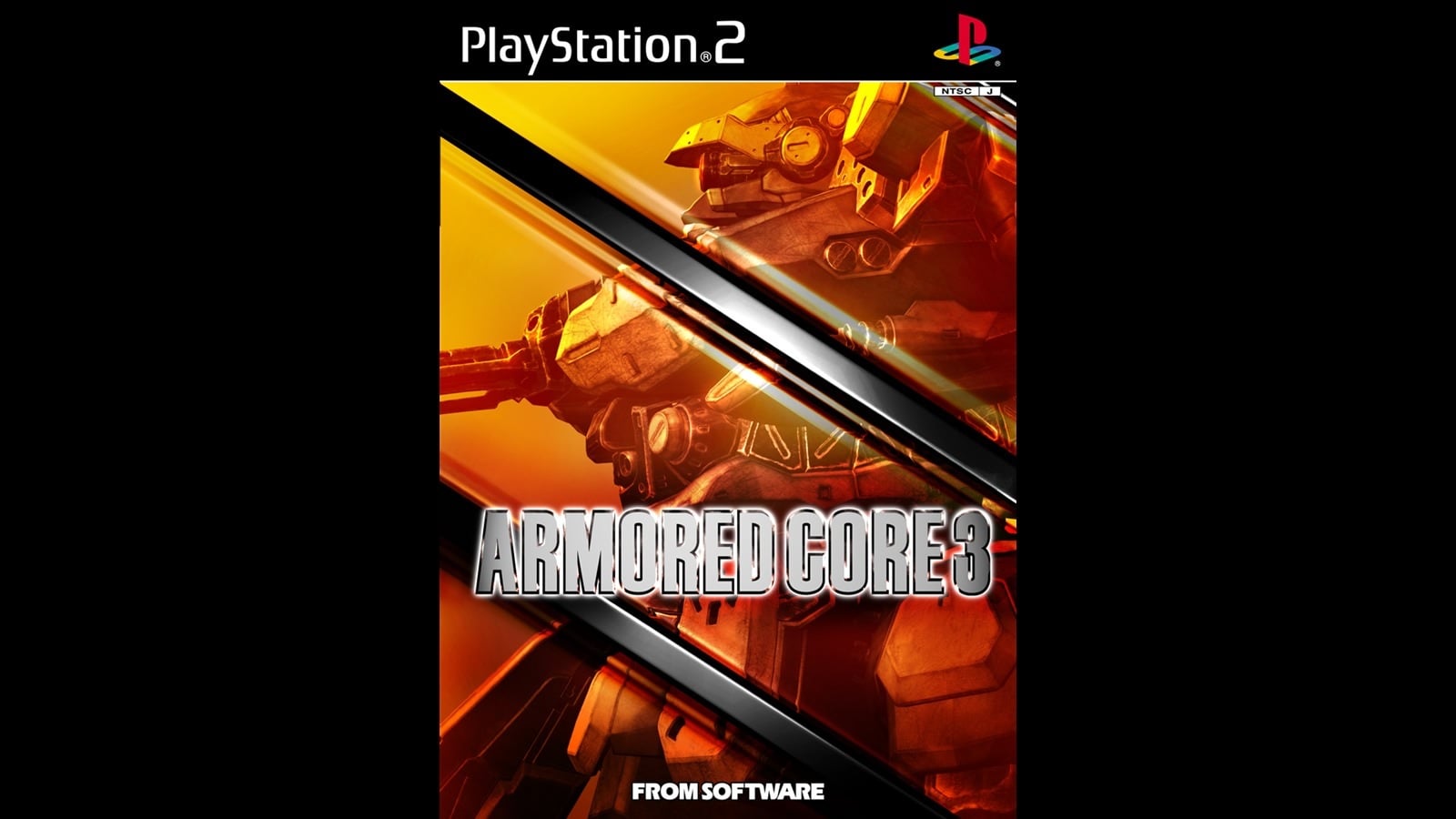
This is my first column for AUTOMATON, so I thought I would cover Armored Core 3 and how it managed to renew my faith in the series.
Back in 2002, I was living in Mie-ken, Japan, and Armored Core 3 was released in April. As I lived in the middle of nowhere, the only place I could get to easily was a 7-Eleven a few miles away on my bike. So I waited up late on launch day, and went down to the store at midnight to pick up my copy.
The following few months after the game’s release had me pretty much obsessively playing the game and unlocking all its secrets. After the disappointing releases of Armored Core 2 and Armored Core 2 Another Age, I had hoped that Armored Core 3 would be a return to the faster-paced form of the original PlayStation games, which I loved.
In fact, it turned out to be much better than that.
While Armored Core 3 built upon elements from the 2nd generation of Armored Core, such as Over Boosting and new parts like Extensions, Insides, and Radiators, it also allowed you to purge used weapons and equip different weapons to your left arm, rather than the standard laser blades or shields.
The game also afforded a new 4-player multiplayer setup, which was amazing, and a new type of core that was called Exceed Orbit. These fired energy shots and would slowly replenish when docked. They also came in three weapon strength types, from high-speed machine gun fire for lightweight cores, to slower, more powerful shots for the heavyweight cores.
Personally, I stuck with the midweights, as that was my preferred weight class. It also meant you could free up the left arm for actual firepower and still have a backup weapon that wouldn’t run out of ammo.
As the Japanese game was released a good five months before the US version, I was one of the few people who was able to talk about the game online and answer people’s questions on the various Armored Core forums I frequented.
There was a big worry after the unbalanced nightmare of the Karasawa Mk2 from the 2nd generation of games, that not only did great damage but also stunned you in place, that Armored Core 3’s parts list wasn’t properly balanced. Unlike in Japan, US players at that time would use all the parts available and not restrict certain ones for tournaments. From their standpoint, if it was in the game, it was meant to be used for multiplayer.
Thankfully, the new Karasawa was much more sensible and required actual skill to use properly. Instead, the focus was much more on physical weapon types, like rifles and especially machine guns. The latter obviously went down very well with my US friends.
The other big change was that the secret Human Plus upgrades from earlier Armored Core games were attached to a new option part called OP-INTENSIFY. Once equipped, it also fills all your option parts slots, and you have to “train” it by doing certain things in specific missions. It was an interesting setup, and again allowed players to switch off the Human Plus abilities for matches.
The latter was a weird one, because while US fans definitely thought all the parts were meant to be used in multiplayer, some of the Human Plus abilities were often criticized. So the addition of OP-INTENSIFY helped to solve those arguments, because you could just not use it.
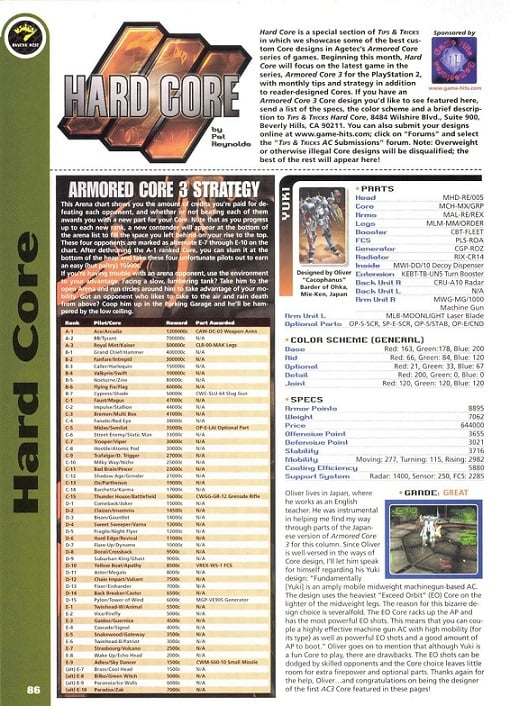
I even had one of the editors from a US gaming magazine called Tips & Tricks contact me and ask for help a few months before the US release. He had trouble with the language barrier in the game, which I assisted him with, but I also offered to copy my 100% game save onto a new memory card and post it to him.
His way of thanking me was featuring one of the designs in the first write-up on the game for the October 2002 issue, a month before the game was released in the US.
Looking back on the game, it also ran much better than the 2nd generation of games, which often had major framerate issues when you fired a volley of missiles, and the mecha designs by Shoji Kawamori were also a huge improvement in terms of the in-game models.
The story was also more involved and mysterious, with it being somewhat similar to the original PlayStation games in terms of being set underground and an evil artificial intelligence running the world.
In general, though, it was a faster, cleaner, and more precise game than the initial 2nd generation of games on the PlayStation 2. I also remember playing online matches in Japan via a USB modem, but the lag was pretty terrible, and it’s amazing to think how far online gaming has come in the past few decades since then.
While I think Armored Core 3: Silent Line is probably the best game in the series on the PlayStation 2, Armored Core 3 definitely helped renew my faith in the series after how I felt let down with the 2nd generation of games. However, it’s worth mentioning that the PlayStation Portable port of the game, released in 2009, is entirely awful and is not worth playing.
Score: 9/10
If you are at all curious about my thoughts on the various Armored Core games, then feel free to check out my reviews over on my site, Mecha Damashii, as well as the series write-up I did for Time Extension. As for the recent Armored Core VI, my review for that is available on Forbes. I have also played and finished every Armored Core game, and I have a YouTube playlist for that as well.