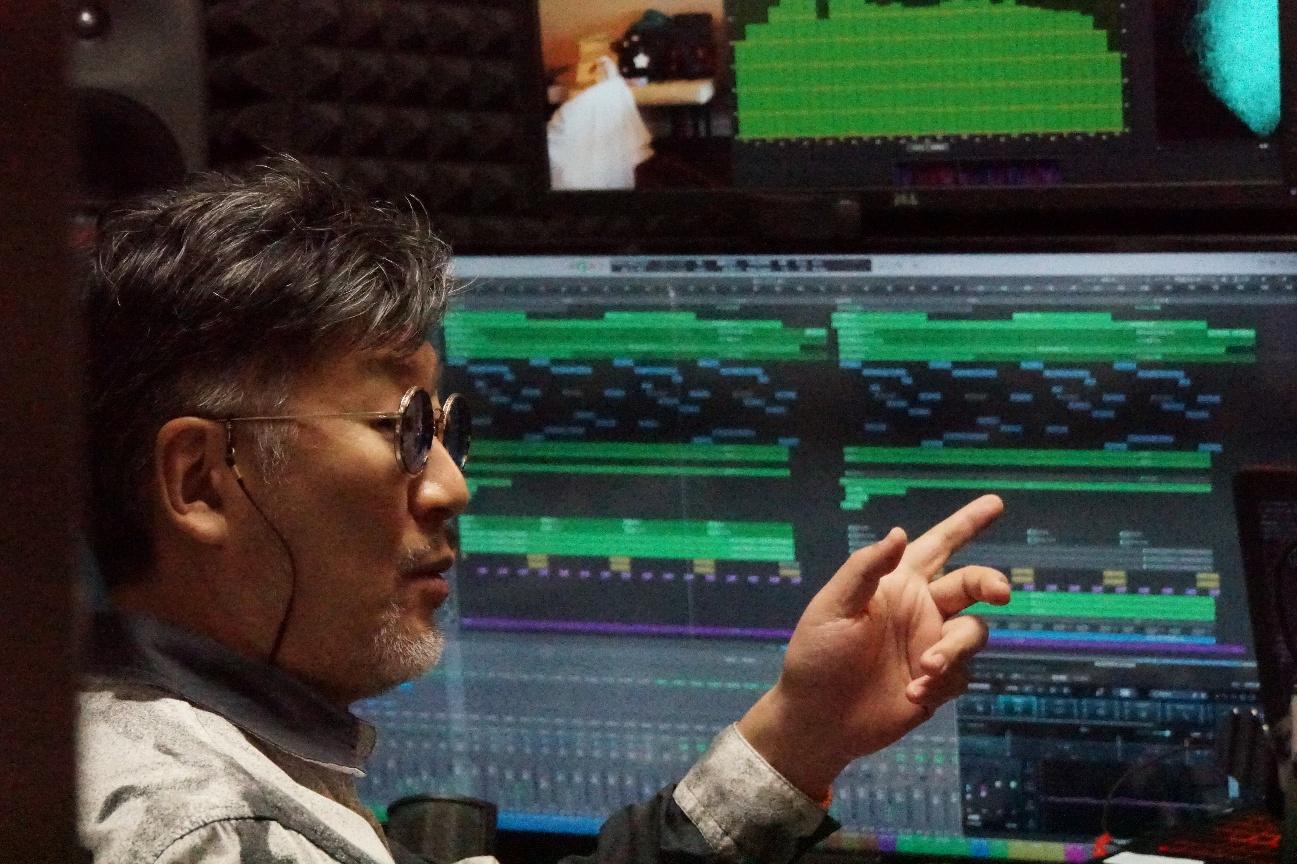
The Hundred Line: Last Defense Academy’s original soundtrack, created by Danganronpa and Digimon Story series composer Masafumi Takada, recently released across digital streaming platforms, with a physical disc scheduled to go on sale in April this year. Commemorating the launch, AUTOMATON sat down with Takada to learn about some the techniques he uses to create an underlying “unease” in his tracks, the influence he draws from ancient Japanese court music, and why his “happy” songs are intentionally simpler than others.
The first track Takada created for The Hundred Line was the titular “HUNDRED LINE,” which also happens to be one of the first songs players hear too. “It’s basically an everyday-life track that plays when nothing special is happening,” Takada says, “but to hint at the extraordinary situation lurking beneath the surface, I built it around sounds that feel unsettling and unstable.”
“Harmonically, I was conscious of things like intentionally omitting the thirds or frequently using ninths, but ultimately, I composed this track by slowly working in the uneasy atmosphere and wavering emotions I felt from the game’s plot while playing the piano. For this one, I was quite free with the bass line,” he explains.

Although they tend to not receive much of the spotlight, Takada says that a game’s “everyday” theme plays an extremely important role. “Once you decide on a song that serves as the daily-life theme, it becomes the starting point for the narrative arc. It makes it easier to plan things like ensuring you can return to that point, or creating various derivations from it. It’s like the game’s normal position or neutral state, the core. Once that’s established, composing the rest of the music later becomes much easier.”
Takada also gave us some insight into “Sirei’s Supervision,” one of The Hundred Line’s most popular tracks. Interestingly, Takada had successfully predicted that this song would be the most popular among overseas players. It also happened to be the most challenging track for him to get right, as it had to convey the mascot character’s unusual energy in a memorable way, much like the character theme song of Monokuma in Danganronpa.

“When you hear the full version, it starts with a four-on-the-floor beat, then shifts to a five-beat rhythm, similar to Creepy Nuts’ “Bling-Bang-Bang-Born” to give recent example. This captures the shift from techno’s four-on-the-floor to contemporary five-beat rhythms. At the beginning, I deliberately play a melody that suggests a five-beat feel, but the kick drum stays on a four-beat. This makes listeners think, It’s not a five-beat, but it’s kind of interesting, leaving them with a slight sense of unease as they listen. Then, in the second loop, I release the five-beat, aiming for that moment when listeners instantly fall in love with the track.”
Takada says his music is full of technical gimmicks like this, and another specific example is getting the listener to “play out” music phrases in their head as they listen. “For example, removing the melody on the second loop, or intentionally leaving out rhythmic fills that you’d expect to come in. It’s an approach to time structure that’s similar to gagaku, the ancient Japanese court music tradition.
In gagaku, a large group plays a phrase together, and then gradually one or two players drop out. The phrase disappears, but in the listener’s head it keeps playing. That makes it easier for the music to imprint itself on your memory. I use that kind of technique in a lot of the tracks [in The Hundred Line].”

When it comes to making the player feel anxiety, like in “Clear Heart” or “Goodbye Hope,” Takada focuses on creating dissonance. “It’s not just about making things dark or heavy,” he explains. “Instead, I leave a bit of pop sensibility in there while introducing slightly off-kilter dissonance, a kind of ‘pop dissonance.’ Because the music is still easy to listen to, those bits of discomfort stand out even more strongly, creating a lingering sense of unease that stays with the player.”
On the other hand, The Hundred Line’s more positive songs, like “The Light Beyond” and “Blue Drops” have a comparatively simpler sound to them, but Takada says this is very much intentional on his side. “Happiness is something people seek out in their everyday lives, and there’s already plenty of music in the world that serves that purpose. Because of that, I believe that if you overdo those moments in a game, it can actually fall flat. In recent game music, you sometimes see happy scenes hammered home with overwhelmingly “happy” tracks. Personally, I feel like that approach doesn’t fully trust the overall flow of the game and its emotional ups and downs. If you go that far, it leaves no room for the player’s emotions to settle.” In this sense, Takada’s “happy” tracks are designed as a kind of small anthesis to recent trends.
The Hundred Line: Last Defense Academy’s Original Soundtrack by Masafumi Takada is out now on digital streaming services including Spotify, Apple Music, iTunes, and is also available for purchase on Steam. A Director’s Edition of the soundtrack will release on disc on April 24.