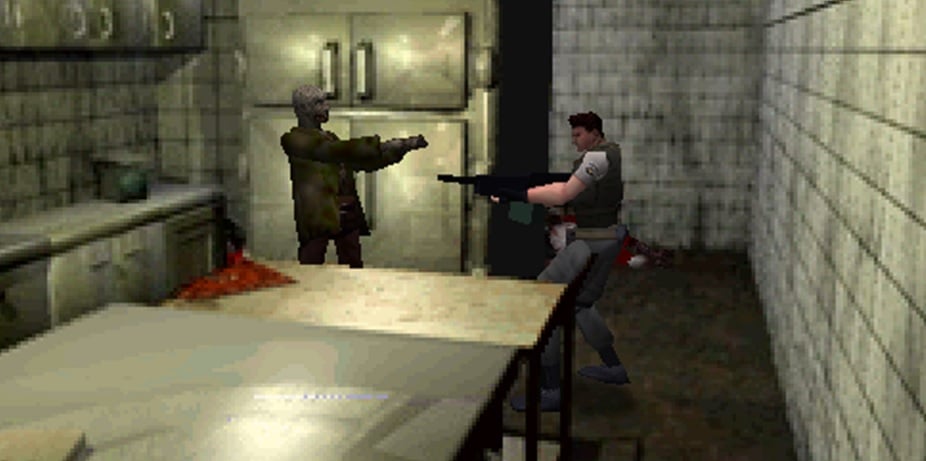
The Resident Evil series is undoubtedly Capcom’s biggest hit, regarded as one of the most influential video games in the horror genre. However, its beginnings were rather humble, and as suggested by developer Hideki Kamiya who worked on the original Resident Evil and directed Resident Evil 2, the first game suffered a huge blow upon release due to insufficient marketing and a “chain of unfortunate events.”
According to Kamiya, in parallel with Resident Evil, Capcom was developing another game, which ended up getting cancelled midway. So, in order to fulfill its contractual obligations, the company had to redirect plans initially intended for the cancelled title to Resident Evil. One infamous example of the shift is the ending theme for the Japanese version of the game (Biohazard), which Capcom was apparently obliged to put in the game with little regards to the wishes of the developers.
“That song was shoved onto Resident Evil after the cancellation of another project which was planned as a tie-in between Capcom and Toshiba EMI (I don’t remember correctly). It was due to such ‘political’ reasons that the song had to be included in the game. I remember the whole team was left dumbfounded when we all listened to the demo tape Mr. Mikami brought,” Kamiya explained in his X post.
The song in question is Yume de owarasenai … (ENG: I won’t let this end as a dream) by singer Fumitaka Fuchigami, which served as the ending theme for the original Japanese version of Resident Evil, and was originally meant to appear in the cancelled game as a collaboration between Capcom and record label Toshiba EMI. Unsurprisingly, the song was replaced in all other versions of the game, including Resident Evil Director’s Cut.
But the “string of bad luck” didn’t stop there. As Kamiya elaborated, “the cancelled title had a contract with V Jump for the early information about the game to be shared exclusively in the magazine. However, since that role was also forced upon Resident Evil, articles about it ended up being published in V Jump, which had a completely different target audience.”
V Jump is a famous shonen manga magazine which primarily caters to young boys of elementary school age. And because of Capcom’s contractual obligations, Resident Evil, being a more mature title, wasn’t able to reach its intended audience, and Kamiya suggests that the contract might have been preventing it from publishing exclusive information in more popular, gamer-oriented magazines. “We couldn’t get a single article in Famitsu, which was the most popular magazine at the time… And that’s why Resident Evil launched without anyone knowing about it…It was a string of bad luck,” he said.
Luckily, this didn’t seem to prevent Shinji Mikami’s game from evolving into one of the most recognized horror franchises, and the somewhat “out-of-place” theme song is now a nostalgic, fond memory for many Japanese gamers who experienced the game on PlayStation back in the day.
Related articles: