
Japan’s Ministry of Internal Affairs and Communications (MIC) recently released the results of its “Family Income and Expenditure Survey” for 2025. According to the data, per-household spending on both game consoles and game software reached record highs in 2025. The statistics are based on a sample of 9,000 Japanese households (of two or more persons), with console and software spending viewed as separate categories.
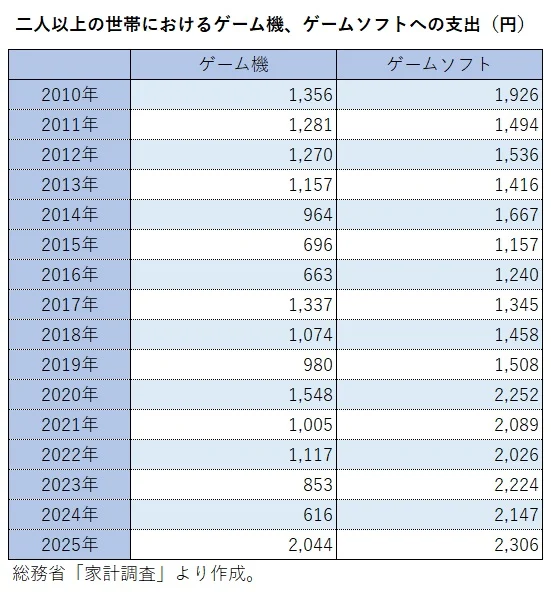
According to the survey, the average annual spending on game consoles among Japanese households in 2025 was 2,044 yen, or about $14 USD. This is the first time since 2010 that average spending on consoles has exceeded 2,000 yen, and the figure represents more than a threefold increase compared to 2024’s 616-yen average.
Previously, the highest spending year for consoles had been 2020, when COVID-19 lockdowns pushed spending to 1,548 yen. The 2025 average surpasses this previous record by 32%.
Meanwhile, console purchase frequency per 100 households was 0.047. This is higher than in 2024 (0.021), but still below the 0.066 recorded in 2020 during the pandemic-driven game industry boom. For reference, the highest purchase frequency on record was 0.081 in 2011, when the Nintendo 3DS and PlayStation Vita launched. The relatively modest increase in purchase frequency in 2025 suggests that rising console prices are the likely cause of higher overall spending.
On the other hand, spending on games themselves in 2025 averaged 2,306 yen (about $15 USD), which is also the highest level since records began in 2010. That said, software spending in Japan has remained in the lower 2,000-yen range on average since 2020, so the increase is more moderate compared to consoles. (Note that software purchase frequency is not tracked in the survey.)
Up until 2009, spending on game consoles and game software was combined under a single “video games” category, so comparisons are limited to post-2010 data. In earlier statistics, 2007 (the year after the PS3 and Wii launched ) recorded 4,561 yen in “video game” spending. That means that technically, at least one of the two categories likely exceeded 2025’s levels back then.
A major factor behind the record console spending in 2025 was the launch of the Nintendo Switch 2 on June 5. According to Nintendo’s financial results for the third quarter of the fiscal year ending March 2026 (announced on February 3), the console had sold a cumulative 17.37 million units worldwide within the first six months of launch, outpacing even the Nintendo Switch.
The PS5 also may have contributed, though. In Sony’s third-quarter results for fiscal 2025, (announced on February 5), the PS5 sold 8 million units between October and December. Although this represents a decrease of 1.5 million units year-over-year, the console, which originally released in 2020, continued to see steady sales in 2025.
Looking at broader trends in the MIC’s 2025 household survey, spending on food in Japan rose by 5.5%. However, in real terms, excluding the effects of inflation, food spending actually fell by 1.2%, suggesting consumers are cutting back on everyday purchases amid the rising cost of living. Against that backdrop, record spending on both consoles and software suggests that people are still more than willing to spend on games, even with inflation weighing on everyday costs.
Related: Japan’s console game market grew by 138.8% in 2025, driven by the Nintendo Switch 2